

 akshit k
Last updated: January 21, 2026
Cyber attacks occur every 39 seconds, costing firms $4.88 million per breach on average, and cybercrime is set to top $10.5 trillion worldwide in 2025.
Old wait-and-see defences fall short as hackers stay ahead. Teams face high costs from downtime and lost customer trust after incidents.
Proactive threat hunting is one of the methods that enable early detection of hidden threats, thereby reinforcing security and reducing the risk to the entire company.
In this blog, we will examine the importance and benefits of proactive threat hunting, as well as the necessity of a robust cybersecurity defence system.
Why Businesses Choose Mitigata for Cybersecurity Defence
Mitigata has secured more than 800 organisations across over 25 industries. What you receive with Mitigata:
- Certified ethical hackers with practical industry experience who can replicate sophisticated attack situations to uncover hidden vulnerabilities.
- A comprehensive security strategy combining compliance, insurance, and resilience to reinforce every level of defence.
- We help teams identify the best security solutions and provide them with faster implementation at 30% lower market rates.
- Availability of 500+ OEM security solutions at reduced prices, enabling companies to use the appropriate tools without paying extra.
- 24/7 assistance from experts who assist you with remediation, monitoring, and sustained risk mitigation
AI-Powered Threat Detection That Never Misses a Beat
Mitigata’s GenAI-enabled SOC spots and stops cyberattacks in real time, cutting response times by up to 90%.

What Is Proactive Threat Hunting?
Proactive threat hunting is the process of searching for threats within an organisation’s network and systems; it occurs before automated alerts are triggered.
The traditional mode of cybersecurity takes action only after detecting a threat, while proactive threat hunting steps in prior to the detection phase, before any damage is done.
Want to know what really happens inside a security Operations Centre and how it protects your business around the clock?
Why Threat Hunting Matters for Cybersecurity
The need for threat hunting has evolved with the increase in sophisticated cyber attacks. Organisations benefit from proactive cybersecurity approaches by:
Discovering Invisible Threats: Finding out about dangers that might not be detected by automated systems.
Decreasing Dwell Time: Reducing the time that hackers stay within the system, thus minimising the damage.
Enhancing Security Posture: Giving the security team a better picture of where the company is vulnerable and what the weaknesses are.
Facilitating Compliance: Helping organisations to comply with regulatory and security demands.
Once organisations start the practice of cyber threat hunting on a daily basis, they will not only be able to detect threats early but also improve their overall defence capability.
Are you counted among those 60% of GRC users who manage compliance manually? It’s high time to check these popular automated GRC tools in Indi
Core Components & Methodology of Threat Hunting
Security teams practising effective threat-hunting depend on the following essential elements
Hypothesis-Driven Hunting: Security professionals form predictions based upon the information provided by the threat intelligence, the tactics, and the attacker patterns.
Data Sources: The logs, endpoint telemetry, network traffic, and authentication records act as the foundation for analysis.
Techniques:
- Behavioural analysis and detection of anomalies
- Memory forensics
- Retrospective threat and hunting to find out about historical compromises
Tools & Frameworks:
- Endpoint Detection and Response (EDR) solutions
- Security Information and Event Management (SIEM) systems
- Threat intelligence platforms and automated detection tools
Typically, the procedure is a cycle of planning, data collection, analysis, investigation, response, and refinement. This way of working guarantees that threats are picked up early and security is strengthened continuously.
Fast-Growing Teams Need Fast-Acting EDR
24/7 endpoint protection, seamless setup and trusted by 800+ security-conscious businesses just like yours.
How does proactive threat hunting improve cybersecurity defences: Key Benefits
Proactive threat hunting strengthens cybersecurity by uncovering hidden risks early, helping teams spot suspicious activity before it turns into a full incident.
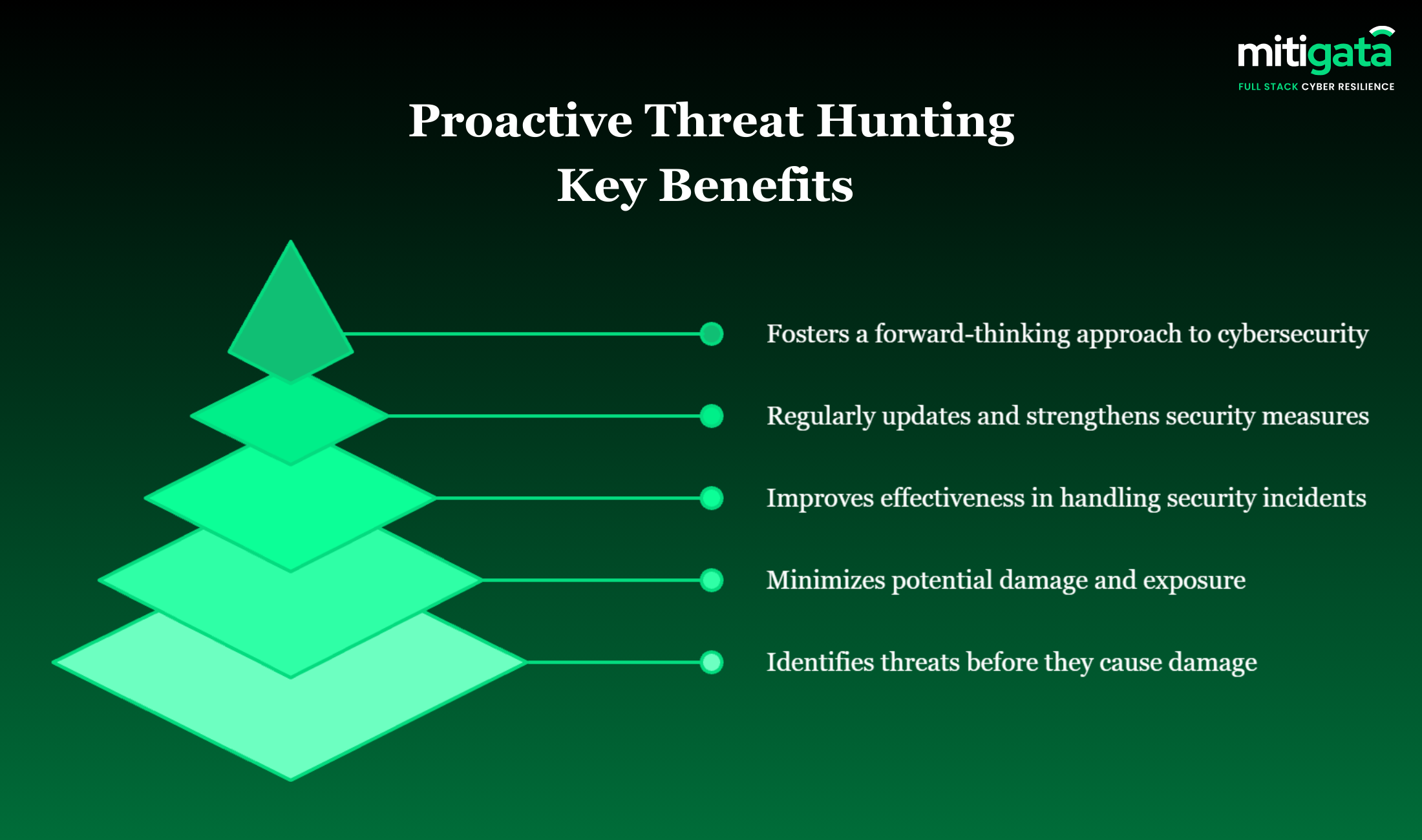
The proactive threat hunting method offers the following benefits:
Detection of Threats Earlier: Advanced threat hunting exposes invisible threats before they are able to grow.
Lower Risk and Dwell Time: A cyber-hunt operation reduces the time the attacker spends in an attack for invisibility.
Incident Response Enhancement: The security teams are able to understand the situation better, and thus, they can act quickly and efficiently.
Continuous Security Improvement: One of the benefits of threat hunting is that it helps identify weaknesses, which, in turn, enables updating detection rules and configurations.
Proactive Security Mindset: The practice of conducting frequent threat hunting builds a strong culture of vigilance that enables the organisation to be at the forefront of the war against potential attacks.
Concerning the rise of cyber attacks in India, learn what business owners can do to protect their databases.
Conclusion
Proactive threat hunting is an essential part of modern cybersecurity strategy. By doing their best to find threats, companies are able to identify and react to the risks faster, cut off the time the attackers stay in the system, and most importantly, keep on improving their defences.
Taking threat hunting as a part of cybersecurity guarantees that the companies will be safe from the most advanced attacks and also have a strong security posture.
Contact Mitigata and let us help you stay ahead of threats!
 areena g