

6293

SOC and SIEM Guide | How They Work Together in Cybersecurity

Security teams in 2025 face over 10,000 alerts every single day. Left unmanaged, that volume does not just create inefficiency;…

Security teams in 2025 face over 10,000 alerts every single day. Left unmanaged, that volume does not just create inefficiency; it creates the gaps that attackers exploit. Two of the most important components in any mature cybersecurity programme are SIEM and SOC.

They are frequently mentioned in the same breath, often confused with each other, and almost universally misunderstood.
SIEM is a technology platform. SOC is a team of people. One collects and analyses security data; the other acts on it. They are not alternatives, they are partners.

This guide explains what SIEM and SOC are, how they differ across key dimensions, how they work together in practice, and how to decide what your organisation needs right now.

Mitigata – India’s Leading SIEM Implementation Partner

Many organisations spend months reviewing SIEM platforms, only to face delays, poor implementation results, and slow vendor support.

Mitigata eliminates these challenges. With 800+ businesses relying on us across India, we bring the best SIEM solutions at the best market rates due to our partnership with leading OEMs. 

Why teams prefer Mitigata:

  • End-to-end execution, from assessment to full deployment.
  • Configurations shaped around your industry’s needs.
  • Smooth integration across your existing infrastructure.
  • Transparent, market-competitive pricing with no hidden charges.
  • Reliable post-deployment assistance that stays consistently available.

Complete SIEM Coverage at The Best Market Rates

We simplify the tech, secure your stack, and support you 24/7—just ask our 800+ happy clients.

SIEM and SOC: The Core Distinction in One Line

SIEM is the technology – it collects, analyses, and alerts. SOC is the team – it investigates, decides, and responds. SIEM gives the SOC its eyes. The SOC gives the SIEM its purpose. Neither works at its best without the other.

What is SIEM

Security Information and Event Management (SIEM) is a software platform that acts as the central nervous system of an organisation’s security infrastructure.

It continuously ingests log and event data from across your entire IT environment, such as firewalls, endpoints, servers, cloud platforms, applications, identity providers, and analyses it in real time to detect suspicious activity and potential threats.

The term SIEM combines two older concepts: Security Information Management (SIM), which focused on log storage and compliance reporting, and Security Event Management (SEM), which focused on real-time threat detection.

Modern SIEM platforms do both and increasingly incorporate AI, machine learning, and UEBA (User and Entity Behaviour Analytics) to detect threats that rule-based systems would miss.

Are you part of the 60% of teams still managing compliance manually? It may be time to explore India’s leading automated GRC platforms.

The rise in ransomware, phishing, and lateral movement across the enterprise has also made SIEM necessary, enabling teams to make informed security decisions rather than relying on guesswork.

Key Ways SIEM Improves IT Security Operations

Read the following ways in which SIEM enhances IT security operations through automated workflows.
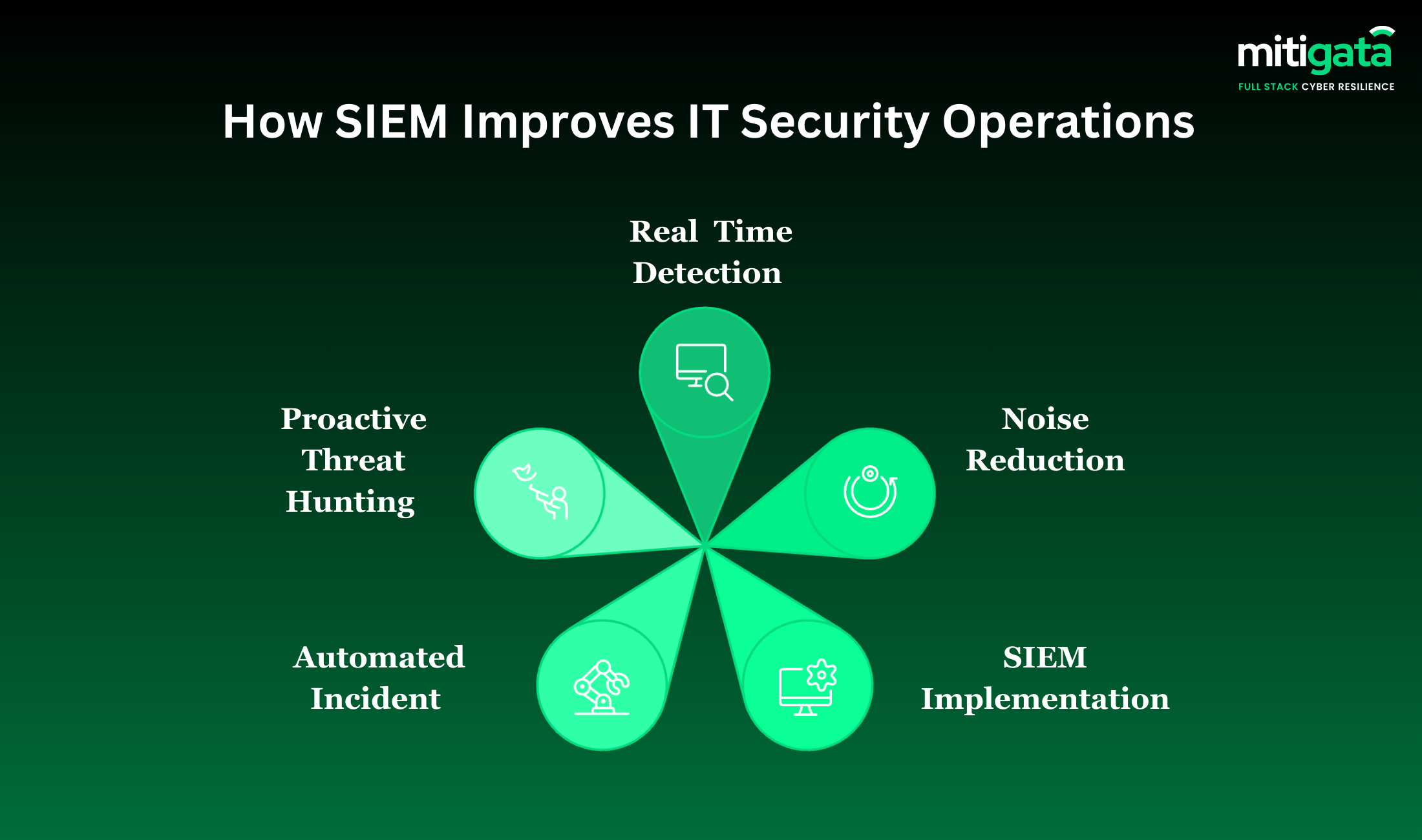
Systematic Detection of Security Events in Real-Time

By correlating events from multiple sources, the SIEM connects signals that might otherwise be missed. For example, repeated failed login attempts combined with unusual network traffic or unexpected privilege escalation.

User and entity behaviour analytics add more context by identifying actions that fall outside normal patterns. By filtering noise and highlighting genuine threats, a SIEM improves detection accuracy and significantly reduces false alerts.

Noise Reduction and Alert Management

One of the main issues in most SOCs is that repetitive, low-value alerts exhaust the SOC team. The SIEM tool enables analysts to focus on the most critical incidents. This prioritisation feature assesses alerts based on their severity, asset importance, and behavioural context.

Seeking for the top SIEM vendors in India. Our In- depth of the top 10 SIEM providers can help you make an informed choice.

One Dashboard. Zero Blind Spots.

Mitigata’s SIEM solutions give you complete visibility without complex setup or hidden costs.

Automated Incident

SIEM incident response functions are often seen to be associated with the SOAR platforms. For instance:

  • Isolating an endpoint
  • Disabling a compromised user account
  • Blocking a malicious IP address
  • Running a forensic collection script
  • Sending tickets or messages to assigned responders.

Proactive Threat Hunting

It plays a major role in threat hunting. When the event history spanning several months or years is stored in a single location, analysts can perform searches that reveal hidden threats.

The use of behaviour analytics makes these searches more comprehensive. A single insignificant or routine activity is part of a larger pattern when viewed alongside other data points.

What is a SOC?

A Security Operations Centre (SOC) is a dedicated team and often a physical or virtual space of cybersecurity professionals responsible for the continuous monitoring, detection, analysis, and response to security incidents across an organisation.

Unlike SIEM, which is a tool, a SOC is a human function: people, processes, and technology working in an integrated operation.

The SOC is the organisation’s frontline defence against cyberattacks. SOC analysts receive alerts from tools like SIEM, investigate them, determine their severity, and take action, from closing a false positive to initiating a full incident response procedure that might involve isolating systems, notifying regulators, and coordinating with law enforcement.

SIEM vs SOC: Key Differences Explained

Here is a comprehensive comparison across every dimension that matters for understanding how SIEM and SOC differ and why that distinction shapes your security investment decisions:

DimensionSIEMSOC
What is it?A software platform/technologyA team of cybersecurity professionals
Primary functionCollect, analyse, and alert on security dataMonitor, investigate, and respond to security incidents
Operates onLog and event data from the IT infrastructureSIEM alerts, threat intelligence, and endpoint telemetry
Response capabilityGenerates alerts; limited automated containment (with SOAR)Full incident response: containment, eradication, recovery
Works 24/7 automatically?Yes, software runs continuouslyRequires shift staffing to achieve 24/7 coverage
Handles context and judgment?No, rule and algorithm-based onlyYes, human analysts interpret business and threat context
Threat hunting capabilityStores data for forensic queries; supports huntingActively hunts using SIEM data and other telemetry
False positive handlingCannot distinguish; generates alerts regardlessTier 1 analysts triage and validate alerts
Compliance reportingAutomated log retention and report generationUses SIEM reports; provides audit support and documentation
Cost structureSoftware licence + infrastructure (₹5L–₹50L/yr for SMEs)Staffing + tools (₹20L–₹2Cr+/yr for in-house SOC)
Outsourceable?Yes, managed SIEM services availableYes, SOCaaS / MSSP models widely available in India
Can it work without the other?Yes, but alerts go unacted onYes, but analysts lack visibility and detection speed

How SIEM and SOC Work Together

The power of SIEM and SOC is not in either individually; it is in their integration. Together, they form a continuous security loop that covers detection, analysis, response, and improvement in a cycle that constantly strengthens over time.

StepWho ActsWhat Happens
Data IngestionSIEMSIEM continuously pulls in logs from firewalls, endpoints, servers, cloud platforms, identity providers, and applications across the entire IT environment
Normalisation & CorrelationSIEMRaw logs are normalised into a standard format. SIEM’s correlation engine cross-references events across sources, connecting individual signals into meaningful patterns
Threat Detection & AlertingSIEMWhen a pattern matches a detection rule, threat intelligence indicator, or UEBA anomaly, SIEM generates an alert with severity scoring and contextual metadata
Alert TriageSOC Tier 1SOC analyst receives the SIEM alert. Validates whether it is a genuine threat or false positive using additional context — user history, asset criticality, threat intelligence enrichment
InvestigationSOC Tier 2For confirmed or suspected incidents, Tier 2 analyst conducts deep investigation: queries SIEM logs, reviews endpoint telemetry, maps attacker behaviour to MITRE ATT&CK framework
Containment & ResponseSOC Tier 2/3SOC initiates incident response: isolates affected systems, disables compromised accounts, blocks malicious IPs, preserves forensic evidence, and notifies stakeholders
Eradication & RecoverySOC + ITThe threat is removed from the environment. Affected systems are restored. Root cause analysis is conducted to understand how the attacker got in
Rule RefinementSOC feeds back to SIEMSOC analysts update SIEM detection rules based on what was learned, reducing future false positives, improving detection of similar threats, and strengthening the entire security loop

SIEM or SOC Or Both? 

The honest answer for most organisations is: both. But budget and maturity are real constraints. Here is a practical framework for deciding where to start and how to scale:

Business SituationRecommended Approach
Startup or very small business (under 50 employees)Start with a managed SIEM service. Alerts can be reviewed by your IT team or an on-call MSSP. Build towards a managed SOC as you grow.
SME with regulatory compliance obligations (BFSI, healthcare, e-commerce handling personal data)Managed SIEM + Managed SOC (SOCaaS) is the most cost-effective path. In-house SOC is unlikely to be economically viable at this scale.
Mid-market enterprise (200–500 employees)Managed SIEM to give your existing team visibility. Consider MSSP for after-hours SOC coverage. Build towards an in-house SOC capability over 12–24 months.
Large enterprise or listed company (RBI, SEBI, or IRDAI regulated)In-house SIEM with in-house or hybrid SOC is the expected standard. Regulatory frameworks effectively require 24/7 monitoring capability.
Business that has experienced a breach or near-missImmediate deployment of managed SIEM + managed SOC. A breach without detection capability makes the next breach significantly more likely.

A practical step-by-step guide for enterprises to implement SIEM and improve visibility, threat detection, and incident response.

Conclusion

With SIEM in place, organisations gain scalable, cost-effective protection against evolving, AI-driven threats while strengthening operational efficiency and regulatory compliance.

In a threat landscape that never slows down, SIEM ensures your security team stays one step ahead.

Looking for an SIEM deployment that works smoothly? Contact Mitigata now to speak with our cybersecurity experts for free.

areena g

Areena is a content and marketing professional with over three years of experience. She enjoys building content strategies and writing pieces that speak clearly to the audience and support real business goals. Her strength lies in turning complex topics into meaningful, reader-friendly content.

Leave a Reply

Your email address will not be published. Required fields are marked *