
In 2025, compliance enforcement reached unprecedented levels, with GDPR fines alone totalling more than $2 billion worldwide.
As regulations grow stricter and audits become more frequent, organisations can no longer afford fragmented visibility or delayed incident detection.
Security Information and Event Management (SIEM) systems address this challenge by centralising logs across the entire environment.
This blog explores how SIEM transforms compliance from a reactive obligation into a proactive, streamlined strategy.
Mitigata – India’s Top SIEM Service Provider
As India’s top full-stack cyber resilience firm, with over 500 security products and a 100% client retention rate, we simplify SIEM selection and deployment.
Through our partnerships with industry leaders such as Microsoft Sentinel, IBM QRadar, and Fortinet, you gain access to premium solutions at the best rates.
What sets us apart?
- Complete execution procedure from initial evaluation to seamless system integration without disruption of services.
- Smooth system integration with no service interruption.
- Clear, market-competitive prices, with complete expense transparency.
- Post-deployment support that will never abandon you.
Complete SIEM Coverage at The Best Market Rates
We simplify the tech, secure your stack, and support you 24/7—just ask our 800+ happy clients.
What is SIEM and Why Compliance Matters
A SIEM is a security tool that collects, analyses, and correlates events across your IT environment.
A single dashboard presents a complete picture of user activity, system behaviour, and potential threats.
SIEM’s role in compliance is significant. This is because almost all regulations in the modern world require it to do the following:
- Log collection
- Monitoring of activities
- Tracking of access
- Reporting of breaches
- Documentation of incidents
- Maintenance of audit trails
- Implementation of data protection measures
Let’s look into the role that SIEM performs in standards posed by major global regulations:
GDPR (General Data Protection Regulation)
Under the GDPR, companies must notify breaches within 72 hours. It is practically impossible to identify a breach in time without a SIEM. Organisations must maintain detailed logs of user access, system changes, and data movement.
Do you belong to the 60% of GRC users who handle compliance by manually? Then it’s high time to check these top automated GRC tools in India.
PCI DSS (Payment Card Industry Data Security Standard)
Firms handling credit or debit card information must remain vigilant, as they must monitor logs and detect any suspicious activity. Departments should prepare quarterly reports and maintain long-term log retention to ensure regulatory compliance.
HIPAA (Health Insurance Portability and Accountability Act)
Healthcare organisations are mandated to maintain detailed audit trails of who accessed patient health data (PHI), when, and why. SIEM is the technology that enables wide-area networking across electronic medical systems, cloud apps, and endpoints.
SOX (Sarbanes-Oxley Act)
Financial systems must be regulated by means of strict controls along with traceability for user actions and data changes. SIEM makes sure that there is integrity and clarity in the financial applications.
One Dashboard. Zero Blind Spots.
Mitigata’s SIEM solutions give you complete visibility without complex setup or hidden costs.
How does SIEM help with compliance?
Here are the four best ways to explain how SIEM helps with compliance:
Centralised Log Management
Modern systems produce an overwhelming volume of logs – firewalls, servers, cloud platforms, identity systems, APIs, databases, and even end-user devices. Without a central place to store and analyse these logs, compliance becomes nearly impossible.
SIEM offers:
- Unified log collection from all systems
- Central retention and archival based on regulation
- Consistent formatting for reports
- Searchable audit trails
- Easy evidence extraction for regulators
Instead of relying on scattered logs across multiple tools, SIEM provides auditors with precisely what they need in a structured, organised format.
Real-Time Monitoring and Alerting
Compliance isn’t just about documentation; it’s about catching issues early. SIEM monitors your environment in real time and detects violations instantly. Examples include:
- Sudden access from unknown locations
- Multiple failed logins (potential brute-force attack)
- Large data exports outside business hours
- High-risk user behaviour
- Suspicious database queries
- Changes in financial records
- Access to sensitive folders without approval
When a suspicious event occurs, SIEM triggers automated alerts to the security team.
This helps organisations react quickly and prevent minor issues from turning into major compliance failures.
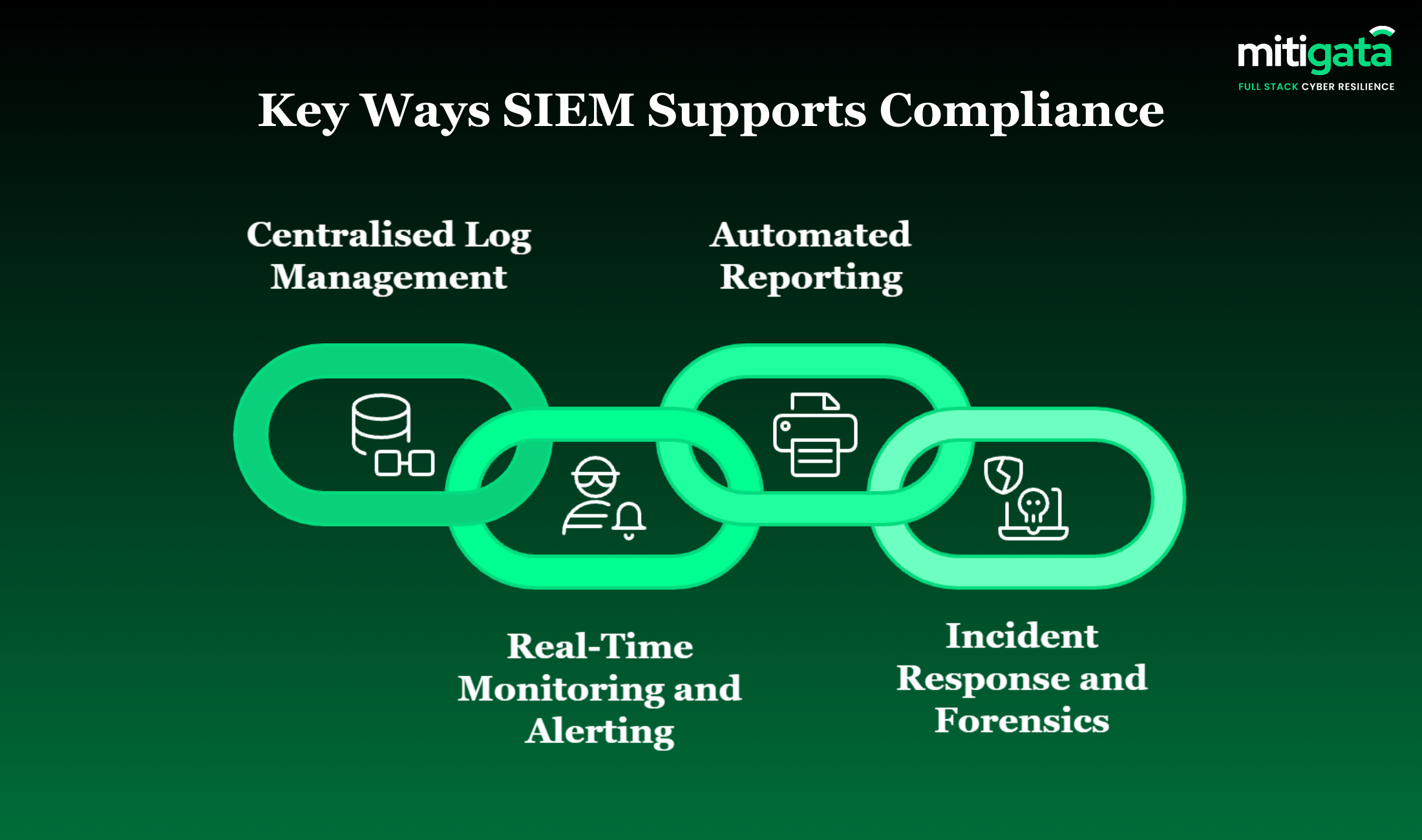
Automated Reporting
One of the biggest challenges during audits is preparing accurate, timestamped, tamper-proof documentation. Without a SIEM, teams spend weeks compiling logs, extracting data, and formatting evidence.
SIEM simplifies this by generating:
- Compliance reports
- Activity summaries
- Incident logs
- Access control reports
- Policy violation reports
- Retention history
- Change management records
- Executive dashboards
These reports can be exported instantly for GDPR, PCI DSS, HIPAA, and SOX audits, saving enormous time and reducing human error.
Looking for the best SIEM providers in India? Our comprehensive analysis of the leading 10 SIEM providers can assist you in making a well-informed decision.
Incident Response and Forensics
When an incident occurs, SIEM provides a clear timeline of:
- What happened
- When it happened
- Who was involved
- Which systems were accessed
- Which data was affected
- What actions were taken
This helps teams quickly identify the cause and close control gaps. Forensic evidence is also essential during regulatory investigations, where incomplete records can result in penalties.
Secure Smart. Pay Less.
Get the best-priced, full-suite security with 24/7 support & seamless implementation.
SIEM Use Cases for Major Regulations
Below is a clear breakdown of how SIEM supports compliance across major regulatory frameworks:
| Regulation | SIEM Benefits | Examples |
|---|---|---|
| GDPR | Helps detect breaches within 72 hours, maintains access logs | Automated alerts for unauthorised access to personal data |
| PCI DSS | Monitors cardholder data activity, supports quarterly evidence | Transaction anomaly detection, log retention |
| HIPAA | Tracks PHI access, maintains audit trails | Reports on who viewed patient data and when |
| SOX | Ensures financial system control integrity | Change logging and user activity trails |
Conclusion
With the enforcement of rigorous regulations and the increase in data breaches, SIEM is now a must-have tool for every business.
It gives comprehensive visibility, makes reporting automatic, lowers risks, and ensures that your business is ready for audits all year round. The ROI is obvious: fewer fines, quicker reporting, easier audits, and a more secure system.
Ready to implement an SIEM that truly works?
Contact Mitigata today and get a free consultation with our cybersecurity experts!