

4005

Why Network Security Is Important for Modern Businesses

What if I told you your company was hacked a few months back, and the intruder is still in your…

What if I told you your company was hacked a few months back, and the intruder is still in your system?

A lot of companies lack a thorough understanding of the importance of their network security and how it can attract new threats.

A late 2025 audit disclosed the fact that 48% of the attacks occurred in Q3 2025 as a result of compromised VPN credentials.

The rapid digitisation of India is directly proportional to the increase in the threat surface. Risk factors include the hybrid work model, BYOD, cloud adoption, SaaS tools, connected IoT devices, vendor integrations, and remote access. Only the right network security controls can allow businesses to detect threats at an early stage.

In this blog, we’ll discover the role and importance of network security. We’ll also walk you through the best practices you can implement.

Mitigata – India’s Leading Cyber Resilience Company

Mitigata is India’s first and only full-stack cyber resilience company, offering solutions across insurance, security and compliance. We help companies:

  • Quantify their cyber risk
  • Monitor their attack surface
  • Track dark web exposure
  • Test employee readiness, and
  • Strengthen brand security

Our platform gives leaders a clear view of where threats exist and how to fix them before attackers find them. When something goes wrong, Mitigata provides immediate support. Its 24/7 incident response team handles forensics, containment, and recovery.

Red teaming exercises help uncover blind spots. Managed SOC, SIEM, XDR, DLP, PAM, and ZTNA solutions keep networks monitored and protected around the clock.

Protect Your Brand From Silent Digital Risks

Get a complete, real-time view of risk, exposures, and active threats, enabling your teams to act decisively before attackers exploit any weakness.

Why Network Security Is Important

Read the following points about the importance of network security in Indian businesses today:

Financial Impact

When a network breach occurs, the costs start piling up immediately. There’s the obvious expense of fixing the breach itself, hiring forensic experts, and restoring systems. Reports from IBM state that the average cost of a data breach runs into millions of dollars, and such a high cost is enough to shut down a business.

Operational Continuity

If on a Monday morning, your employees arrive at work and can’t access any files. Your CRM system is frozen, and your production is halted. Ransomware attacks create exactly this situation, and they’re happening daily. Without proper network security, a single infected email attachment can bring your entire operation to a stop.

Compliance requirements

Whether you’re in India, Europe or some other place, your business is probably subject to data protection regulations. There are legal obligations that, if not met, might result in severe repercussions. The issuing of penalties by the regulators is mainly caused by poor security of the network, which results in breaches of data.

Companies relying on cloud and remote access

The majority of the companies are already operating in hybrid environments. Employees work from home, co-working spaces, hotels and cafes. Thus, the attack surface is extended, and the demand for robust access controls, segmentation, and monitoring is heightened.
What Are the Best Practices for Network Security?

The following is a detailed breakdown of the best practices for network security:

Install a Multi-Layered Protection

There is no such thing as a security tool that can do the job alone. Hackers always have a backup plan, and that’s why companies have to resort to a multi-layered approach, commonly referred to as the defence in depth. The purpose of each layer is to slow down, reveal, or stop the attack.

Your defence layers should include:

  • Perimeter protection: Firewalls and IDS or IPS to filter traffic
  • Network segmentation: Separate systems so that attackers cannot freely move.
  • Endpoint protection: Antivirus, EDR, and hardening of the devices.
  • Application security: Safe coding and fixes for vulnerabilities.
  • Data encryption: Encryption of data during transmission and storage.
  • Access controls: Limit access according to role and necessity.

Example:

A healthcare clinic may implement a firewall as the first line of defence, create isolated networks for medical records and administrative work, use encrypted databases, and apply role-based access such that receptionists have no access to complete patient files.

If you’re unsure which security approach fits your stack, this guide explains the differences between EDR, XDR, and MDR

Tighten Authentication and Access Control

Weak passwords and illegal access to accounts are some common methods of attack. The use of multi-factor authentication (MFA) has become a necessity in the case of remote access and critical systems.

Key steps include:

  • Enabling MFA for all VPN, cloud apps, and internal tools
  • Using IAM systems to centralise identity control
  • Implementing single sign-on (SSO)
  • Auditing user access regularly
  • Automatically removing access when employees leave
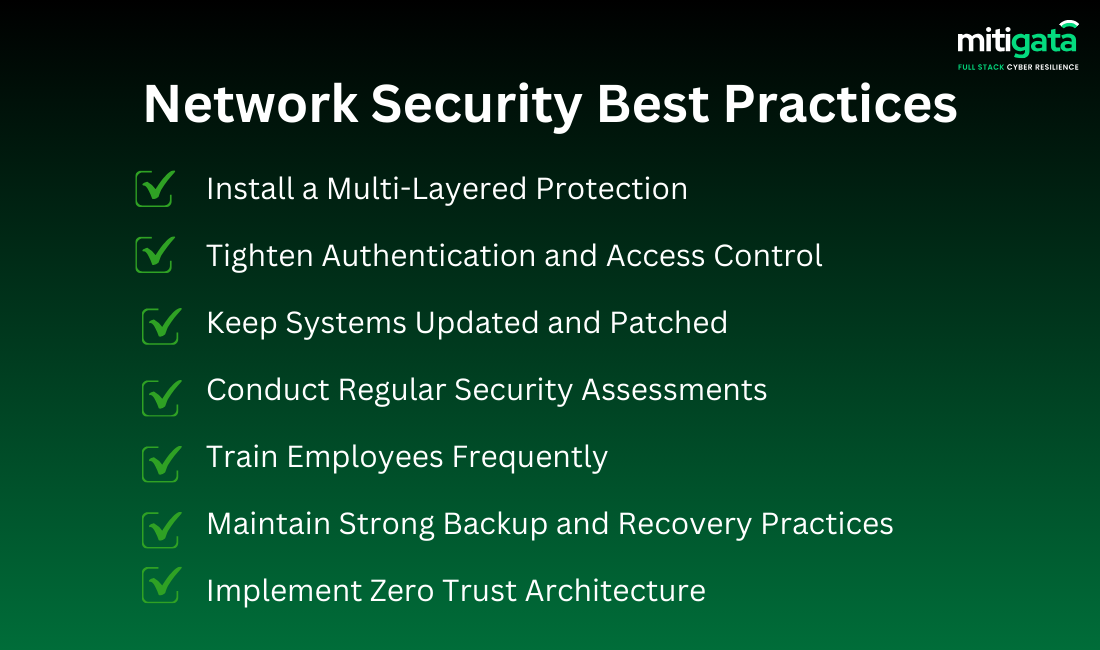
Keep Systems Updated and Patched

Many breaches occur because companies delay updates. Vulnerabilities are discovered constantly, and attackers quickly exploit them. A structured patch management process closes these gaps before criminals use them.

Your patch cycle should include:

  • Inventory of all devices, applications, and network equipment
  • Subscribing to vendor security alerts
  • Testing patches safely before deployment
  • Applying critical patches within days
  • Updating routers, switches, and firewall

Example:

The WannaCry attack spread through a known Windows vulnerability. Businesses that patched early stayed safe. Those who did not faced heavy losses.

Monitor Your Environment Continuously

You cannot defend what you cannot see. Continuous monitoring helps identify unusual behaviour before it becomes a full-scale incident

Monitor:

  • Failed and unusual login attempts
  • Access to sensitive files
  • Sudden spikes in network traffic
  • Configuration changes
  • File integrity on important servers

A SIEM or SOC setup can alert your team when something suspicious occurs, such as logins from two countries within minutes or unexplained data transfers.

The Only Partner Covering Risk To Recovery

Mitigata’s SOC, SIEM, XDR, and DLP ensure real-time detection, automated defense, and continuous visibility across every critical environment.

Conduct Regular Security Assessments

Security gaps only come to light when you look for them. Assessments help organisations stay proactive.

Recommended assessments:

  • Vulnerability Scanning: Monthly automated checks
  • Penetration Testing: Ethical hacking to find hidden flaws
  • Security Audits: Policy and configuration review
  • Red Team Exercises: Simulated advanced attacks for larger organisations
  • These assessments reveal weak controls, misconfigurations, and blind spots.

Train Employees Frequently

Human error remains one of the biggest risks. A trained workforce reduces successful phishing, social engineering, and accidental data leaks.

Effective training programs include:

  • Quarterly phishing simulations
  • Guidance on password safety
  • Social engineering awareness
  • Clear reporting procedures for suspicious emails

Maintain Strong Backup and Recovery Practices

Backups are your last line of defence against ransomware and destructive attacks. A backup is only useful if you can restore it.

Best practices include:

  • Follow the 3-2-1 rule (3 copies, 2 media types, 1 offsite)
  • Automate daily backups
  • Keep backups isolated from your network

Discover what the DPDP Act 2025means for your organisation and how it changes the way businesses manage personal data responsibly today.

Implement Zero Trust Architecture

Zero trust assumes no user or device is trustworthy by default. Everything must be verified before access is granted.

Zero trust principles mean:

  • Verify every access request
  • Use least privilege for all roles
  • Assume breach and limit movement
  • Apply segmentation across the environment
Category Best Practices
Defense Layers Firewalls, segmentation, endpoint security, encryption
Identity & Access MFA, IAM, SSO, least privilege
Patching Regular updates, vendor alerts, and device patching
Monitoring SIEM, SOC, anomaly detection
Assessments Vulnerability scans, pentests, audits
Workforce Phishing training, awareness programs
Backups 3-2-1 rule, isolated backups, restore testing
Network Controls Firewalls, IDS, segmentation
Zero Trust Verify everything, least privilege

Monitor Threats Before They Become Incidents

Continuously track attack surface changes, dark web leaks, brand misuse, and operational weaknesses long before they escalate.

How Businesses Can Strengthen Their Network Security Strategy

Let’s look at how to build and strengthen your network security strategy practically:
1. Conduct a detailed risk and asset assessment

  1. Build a layered defence
  2. Implement secure remote access
  3. Use AI-driven monitoring
  4. Set clear security policies
  5. Assess third-party and vendor risk
  6. Track dark web leaks
  7. Invest in cyber insurance
  8. Regularly run red teaming and penetration testing

Discover the most common cyber threats that could ruin your business in this digital age!

Conclusion

There is no doubt that threats are real and growing every day. Generative AI is making attacks smarter. Compromised credentials are giving attackers easy entry. And automated defences alone aren’t enough.

From insurance to attack surface monitoring, SOC, DLP, red teaming, and rapid incident response, Mitigata supports every layer of defence.

Book a Free call today!

deepthi s

Leave a Reply

Your email address will not be published. Required fields are marked *