3073

DDoS Attack Explained: How to Prevent, Detect & Protect Your Business

Right now, somewhere in the world, a business just like yours went offline. Not because of a sophisticated hack. Not…

Right now, somewhere in the world, a business just like yours went offline.

Not because of a sophisticated hack. Not because someone cracked their firewall. Simply because too many requests hit their server at once, and it buckled.

That’s a DDoS attack in cyber security and it’s far more common, far cheaper to launch, and far more devastating than most business owners realise.

2,200+ DDoS attacks happen every day globally. ₹5 Crore+ is the average cost of downtime per hour for a mid-size business. 54% of attacks target businesses with fewer than 250 employees.

Here’s what makes it worse: most attacks peak within the first 5 minutes. By the time your IT team notices something is wrong, the effects of a DDoS attack are everywhere.

This guide covers DDoS attacks in network security in detail, along with their detection, prevention, mitigation, and how to choose the right DDoS protection solution for your business.

DDoS Attack Full Form, Meaning and Definition

DDoS attack full form: Distributed Denial-of-Service Attack.

A DDoS attack in network security is a malicious attempt to make a server, service, or network unavailable to legitimate users by flooding it with traffic from thousands or millions of compromised devices simultaneously.

The DDoS attack meaning is in the name: distributed means the attack comes from many sources at once, denial-of-service means legitimate users are denied access to the targeted resource.

Looking for a complete privileged access management guide? Here’s everything you need to know.

Why Businesses Choose Mitigata for DDoS Protection

Mitigata is India’s leading cyber resilience company, trusted by 800+ businesses across 25+ industries. It is built for organisations that can’t afford downtime and don’t want the complexity of managing a full in-house security team.

Mitigata delivers unified defence through advanced technology, automation, and expert-led monitoring, ensuring your business stays protected even during high-volume DDoS attacks.

What do you get?

    • Real-Time DDoS Attack Detection: Threats are identified before they impact your users
    • Automated DDoS Attack Mitigation: Instant response with no manual intervention required
    • 24/7 SOC Monitoring: Security experts continuously monitor your infrastructure
    • AI-Driven Threat Intelligence: Proactive prevention instead of reactive firefighting
    • Fast Deployment: Get protected quickly without complex setup or downtime
    • Personalised Security Policies: Security tailored to your business risk and environment
    • End-to-End DDoS Attack Solution:  Detection, mitigation, response, and reporting in one unified platform

Know Exactly Where You’re Exposed

Mitigata’s VAPT identifies real-world vulnerabilities before they turn into real-world damage.

DoS vs DDoS: What’s the Difference?

Before going further, it’s important to understand the distinction between a DoS and a DDoS attack because they require very different responses.

FactorDoS AttackDDoS Attack
Traffic SourceSingle machine / IPThousands or millions of devices
ScaleLimited by one systemMassive, botnet-driven
DetectionEasy (block one IP)Difficult (distributed sources)
MitigationFirewall or rate limitingScrubbing, anycast, specialised services
Cost to LaunchVery lowDDoS-for-hire (~$5/hour)
Prevalence TodayMostly obsoleteDominant attack method

Explore the top cyber risk quantification companies and how they help businesses measure real financial risk.

DDoS Attack Explained – How It Works Step by Step

Understanding how a DDoS attack works is the first step to stopping one.

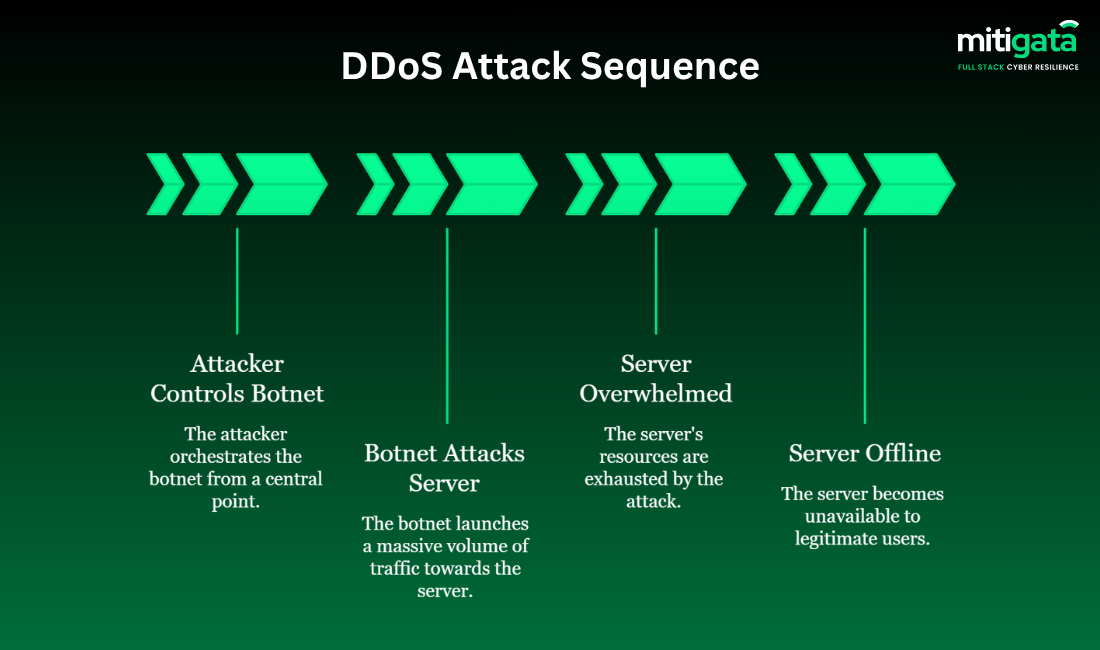
Botnet Creation – Attackers silently infect thousands of devices, computers, IoT gadgets, and cloud servers with malware. These devices form an army called a botnet. The owners usually have no idea.

Command & Control – With one command, attackers remotely activate the entire botnet and point all infected devices at your IP address or domain.

Traffic Flooding – Every infected device fires simultaneous requests at your server – far beyond anything it was built to handle.

Resource Exhaustion: Your bandwidth maxes out. Your CPU spikes. Memory runs dry. The server slows to a crawl, then stops responding entirely.

Step 5 – Service Disruption Real users hit error pages, infinite loading screens, or a completely offline site. Revenue stops. Support tickets flood in. Panic sets in.

ddos attack in network security

DDoS Attack Types: Know What You’re Up Against

One of the most important things to understand about DDoS attacks in network security is that they’re not all the same. Different DDoS attack types target different parts of your infrastructure, which is exactly what makes them dangerous.

Attack TypeWhat It TargetsExampleDifficulty to Stop
VolumetricBandwidthUDP floods, ICMP floodsModerate
ProtocolNetwork / server resourcesSYN floods, Ping of DeathHigh
Application LayerApps / APIsHTTP GET/POST floodsVery High
Multi-VectorMultiple layersCombined attack methodsExtreme

Volumetric Attacks

The most common DDoS attack type in network security. Floods your bandwidth with junk traffic until nothing legitimate gets through. Easy to scale, hard to absorb without cloud-based scrubbing.

Protocol Attacks

xploit weaknesses in network protocols to exhaust server or firewall resources. A SYN flood, for example, sends thousands of half-open connection requests, tying up your server’s connection table.

Stay Protected Against DDoS Attacks

Mitigata helps you detect threats early, reduce downtime, and stay ahead with continuous risk monitoring.

Application Layer Attacks

The most dangerous DDoS attack type in network security today. These mimic real user behaviour – making them nearly invisible to tools that only look for traffic volume spikes.

Multi-Vector Attacks

Modern attackers rarely use just one method. Multi-vector attacks combine all three types simultaneously – making DDoS attack detection harder and mitigation far more complex. These are now the norm, not the exception.

A practical Gordon cyber risk management platform guide to help you turn cyber risk into business decisions.

DDoS Attack Examples

Understanding DDoS attack examples from the real world shows just how high the stakes are.

GitHub 2018 (1.35 Tbps)

At the time, the largest DDoS attack ever recorded. GitHub was taken offline for approximately 10 minutes by a memcached amplification attack that generated 1.35 terabits per second of traffic.

Developers worldwide were locked out mid-workflow. GitHub survived because it had Akamai’s Prolexic service, which absorbed the traffic within minutes of engagement.

Dyn DNS 2016 (Mirai Botnet, ~1.2 Tbps)

A Mirai botnet, built almost entirely from compromised IoT devices, including CCTV cameras and home routers, took down Dyn, a major DNS provider.

The collateral damage was staggering: Twitter, Netflix, Reddit, Spotify, and dozens of other platforms went offline for hours across the US and Europe. This remains one of the most significant DDoS attack examples, demonstrating how critical shared internet infrastructure is and how fragile.

Amazon Web Services 2020 (2.3 Tbps)

The largest DDoS attack in AWS history at the time, peaking at 2.3 terabits per second. AWS Shield absorbed the attack before it caused significant disruption. A demonstration that cloud-scale defences can handle hyper-volumetric events if they are in place before the attack arrives.

Cloudflare October 2024 (5.6 Tbps, World Record)

The largest DDoS attack ever recorded occurred during the week of Halloween 2024. A 5.6 Tbps attack that Cloudflare’s autonomous defence systems detected and blocked without human intervention.

Just months later in May 2025, Cloudflare blocked a 7.3 Tbps attack, setting a new record. These are now the new normal for well-resourced attackers.

Indian Banking Sector 

Indian financial institutions have faced repeated DDoS attack waves targeting payment infrastructure and UPI transaction systems. The combination of high transaction volumes, regulatory visibility, and sometimes under-resourced security teams makes Indian BFSI a consistent target.

These incidents have drawn CERT-In and RBI regulatory attention and directly informed new cybersecurity mandates for the sector.

This list of best Data Security Posture Management (DSPM) tools breaks down features, use cases, and what actually matters.

DDoS Attack Detection: Catch It Before the Damage Spirals

Early DDoS attack detection is the difference between a 10-minute blip and a 10-hour crisis. Most businesses detect attacks too late – because they’re watching the wrong signals.

Warning signs you’re under attack:

  • Sudden, unexplained spike in inbound traffic – especially from unfamiliar geographies
  • Server response times are degrading without any internal change
  • Requests hammering a single endpoint repeatedly
  • DNS resolution failures or abnormal query volumes
  • Bandwidth saturation alerts are triggering across multiple nodes at once

DDoS Threats Are Rising. Are You Ready?

Protect your systems with Mitigata’s advanced detection and response platform.

DDoS Attack Prevention: How to Stop It Before It Starts

DDoS attack prevention isn’t a single tool or a one-time setup. It’s a layered strategy, combining technology, process, and human expertise.

Establish Traffic Baselines:  You can’t prevent what you can’t recognise. Know your normal traffic patterns at different times of day, week, and month.

Deploy Real-Time AI Monitoring: Effective DDoS attack prevention starts with tools that analyse traffic continuously and flag anomalies automatically, not tools that wait for a human to notice.

Implement Rate Limiting & IP Filtering:  Automatically block IPs exceeding request thresholds. Use geo-blocking for regions you don’t serve. Allowlist known clean IPs.

Enable Load Balancing & Redundancy:  Distribute traffic across multiple servers or regions. No single point of failure means the attack has no single target to overwhelm.

Use a CDN with DDoS Scrubbing: Route traffic through a CDN that absorbs and filters volumetric traffic before it ever reaches your origin server.

24/7 SOC Monitoring: Technology alone isn’t enough for true DDoS attack prevention. Pair automated detection with human expertise, especially for complex multi-vector attacks that need judgment calls.

Build and Test an Incident Response Plan:  Run a DDoS attack test in a controlled environment. Know exactly who does what in the first 10 minutes of a real attack. A plan that’s never been tested is not a plan.

Looking for the best pen testing tools? This guide covers the top options you should know.

DDoS Attack Mitigation: What to Do When You’re Under Attack

Even with the best prevention, you need a DDoS attack mitigation strategy ready to activate the moment an attack begins.

DDoS attack mitigation in real time:

  • Traffic scrubbing – redirect attack traffic to a scrubbing centre where malicious packets are filtered out before clean traffic is forwarded to your server
  • Blackholing – route all traffic to a null route as a last resort to protect the broader network (your site goes down, but the network survives)
  • Anycast diffusion – spread attack traffic across a global network of servers, so no single point gets overwhelmed
  • Rate limiting at the edge – drop requests from IPs exceeding thresholds at the CDN or load balancer level, before they hit your origin

DDoS Attack Solution: Choosing the Right Protection

There’s no one-size-fits-all DDoS attack solution. The right choice depends on your business size, technical capacity, and risk profile.

Solution TypeBest ForImpact / What It Does
Cloud-Based DDoS ProtectionSaaS, e-commerce, web appsAbsorbs large traffic spikes and keeps apps online
On-Premise HardwareLarge enterprises with dedicated infrastructureBlocks malicious traffic and gives full control
Managed Security Service (MSSP)SMBs and growing companiesProvides 24/7 monitoring and rapid response
Hybrid ApproachBFSI, healthcare, high-risk sectorsCombines scale and control for stronger protection

Conclusion 

DDoS attacks in cybersecurity are not a matter of if, they’re a matter of when.

They’re automated, increasingly cheap to launch, and devastatingly effective against businesses relying on outdated or reactive security. Understanding the DDoS attack meaning, recognising the types, knowing the effects, and having a clear detection, prevention, and mitigation strategy in place is the new baseline.

Contact Mitigata today to secure your business against DDOS risks.

Frequently Asked Questions About DDoS Attacks

What is the full form of a DDoS attack?

DDoS stands for Distributed Denial-of-Service. A DDoS attack is a cyberattack in which thousands or millions of compromised devices are used simultaneously to flood a target server, network, or application with traffic, making it unavailable to legitimate users.

What is the difference between a DoS and a DDoS attack?

A DoS (Denial-of-Service) attack originates from a single machine and a single internet connection. A DDoS attack is distributed and launched from thousands of devices simultaneously through a botnet. DDoS attacks are harder to detect, harder to block, and capable of far greater traffic volume than a DoS attack.

What are the main types of DDoS attacks?

DDoS attacks fall into four main categories: volumetric attacks (flooding bandwidth with junk traffic), protocol attacks (exploiting TCP/IP weaknesses like SYN floods), application layer attacks (targeting Layer 7 with requests that mimic real user behaviour), and multi-vector attacks (combining multiple types simultaneously). Multi-vector is increasingly the norm.

How do you detect a DDoS attack?

Key detection signals include unexpected traffic spikes from unfamiliar geographies, single endpoints receiving abnormally high request rates, DNS resolution failures, bandwidth saturation across multiple nodes, and legitimate users reporting access problems while system monitoring shows no errors. AI-powered traffic analysis is the most reliable detection method.

How can you prevent a DDoS attack?

DDoS attack prevention requires a layered approach: traffic baseline monitoring, AI-powered anomaly detection, rate limiting and geo-blocking, CDN with scrubbing capability, load balancing for redundancy, regular DDoS attack testing to validate your defences, a tested incident response plan, and 24/7 SOC monitoring. No single tool is sufficient on its own.

What should you do during a DDoS attack?

Activate your incident response plan immediately. Engage your DDoS mitigation provider or MSSP to redirect traffic through scrubbing. Apply rate limiting and IP blocking at the edge. Communicate with affected users. Document the incident for regulatory reporting if your business operates in a regulated sector. Do not shut down all traffic without mitigation in place; blackholing is a last resort, not a first response.


areena g

Areena is a content and marketing professional with over three years of experience. She enjoys building content strategies and writing pieces that speak clearly to the audience and support real business goals. Her strength lies in turning complex topics into meaningful, reader-friendly content.

Leave a Reply

Your email address will not be published. Required fields are marked *