
 deepthi s
In today’s hyperconnected world, cyber threats like ransomware and AI-driven attacks are rising fast. Organisations now face more than 2,300 breaches every day, with global losses expected to exceed $10 trillion in 2025.
Governance, Risk, and Compliance (GRC) in cybersecurity helps organisations cut through this chaos. It provides a structured way to meet regulations, protect critical assets, and keep the business resilient.
This blog explains how each GRC pillar functions, why it matters for organisations, and reviews key frameworks and supporting platforms.
Mitigata: India’s Trusted GRC Security Partner
With a portfolio of 500+ cyber solutions and extensive experience in insurance, security, and compliance, Mitigata helps organisations with a real-time view of risk and compliance.
What you get with Mitigata GRC Platform:
Continuous Updation
The platform keeps your security strategies up to date by highlighting gaps, refreshing controls, and guiding timely adjustments.
Cost-Effective and Scalable
It reduces dependence on multiple tools and manual effort by automating routine tasks, helping organisations save both time and operational expenses.
Instant Alerts and Detailed Reports
Notifications are sent the moment a gap or issue appears, allowing teams to address concerns before they develop into larger problems.
Unified Management Dashboard
All GRC activities, from risk identification to compliance reviews, are managed through a single, structured dashboard to streamline coordination.
Clear Control Tracking
Each task’s status is visible at a glance, whether pending, in progress, or completed, making follow-ups and accountability simple.
One platform to Manage governance, risk, and compliance.
Track open risks, control status, vendor assessments, and audits instantly with Mitigata’s cost-effective and scalable GRC platform.
What is GRC in Cybersecurity?
GRC in cybersecurity is the framework that involves governance, risk management, and compliance to ensure the security of information programs. These segments are integrated to facilitate the movement of top management, security teams, and compliance functions.
Governance
Governance is mainly about the direction, supervision, and formation of policies. It also represents the values of an organisation regarding cybersecurity and guides the teams in taking the right and consistent measures.
The major components are:
- Information security policies
- Leadership responsibility
- Distinct roles and duties
- Reporting lines
- Cybersecurity governance and compliance regulations
- Integration with organisational objectives
Risk Management
Risk management identifies threats, assesses their impact, and takes appropriate steps to reduce risk. With the increasing use of cloud tools, third-party applications, and remote access, the risks have spread over the networks and endpoints.
Basic functions are:
- Threat assessment
- Vulnerability scanning
- Control selection
- Risk scoring
- Incident reviews
This is crucial for governance in information security and risk management as it keeps the focus on the most critical threats while ensuring stability in operations.
Choosing the wrong ISO 27001 tool can slow everything down. Here’s a closer look at the best ISO 27001 tools that truly help teams stay compliant.
Compliance
Compliance ensures an entity meets government-set industry standards and security requirements. The following are some global security standards:
- GDPR
- HIPAA
- SOX
- ISO 27001
- PCI DSS
Control reviews, documentation, evidence collection, audit preparation, and mapping controls to standards are some of the activities involved in compliance.
From Policy to Proof, Manage Everything in One Place.
Mitigata GRC streamlines compliance tasks so you save time, reduce errors, and focus on what really matters.
Why GRC Matters Now
GRC is more crucial than ever, as attackers increasingly use automation and AI to exploit and target the weakest organisational controls.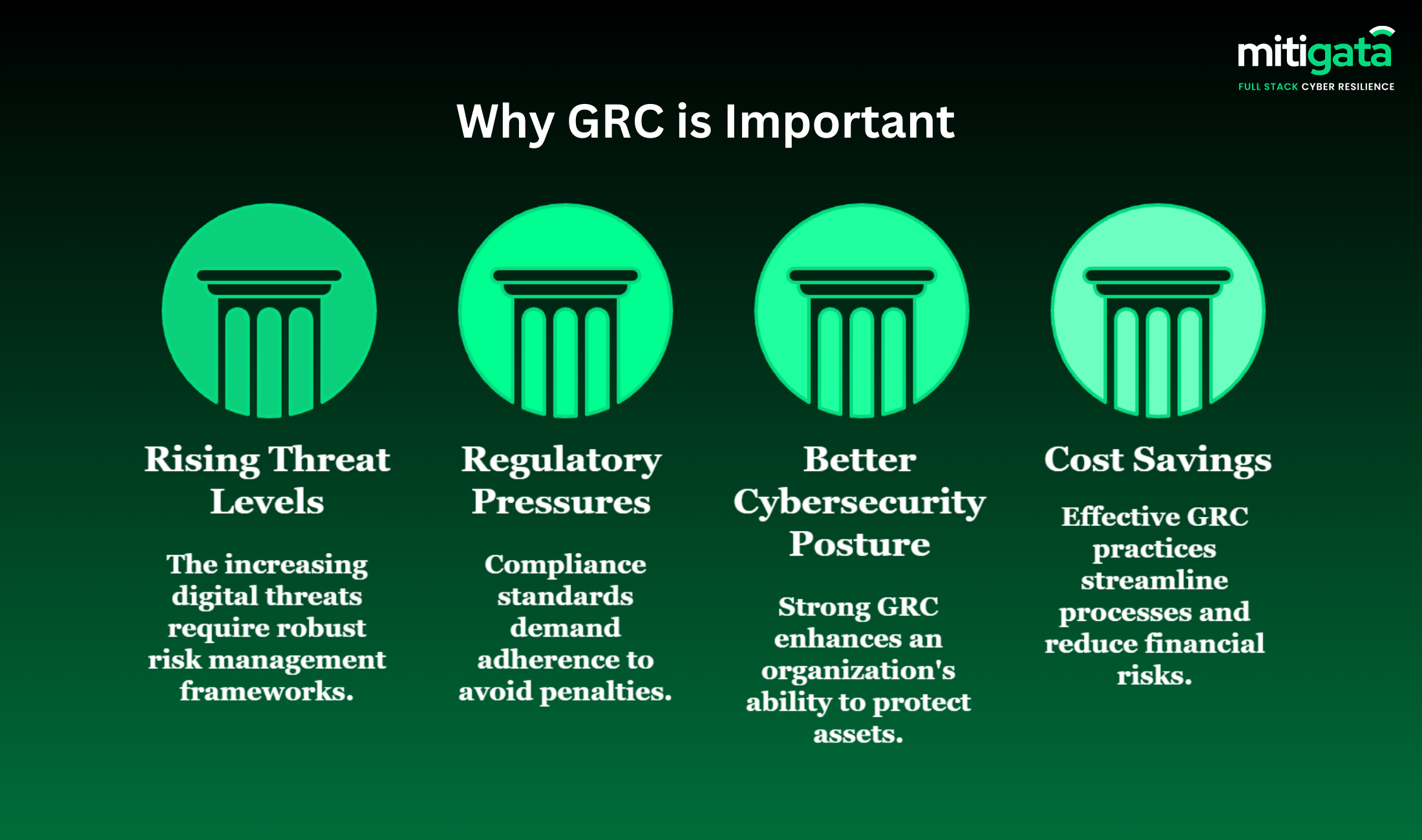
Rising Threat Levels
Ransomware remains the most damaging cyber threat. Double extortion is one of the methods they use. AI-driven phishing is harder to detect, and endpoint attacks evade conventional protections. Companies still have their risk posture undefined, and thus, they are unprotected.
Regulatory Pressures
Government regulations worldwide have become more stringent across data security, breach reporting, cloud protection, and consumer rights. Penalty severity for non-compliance continues to increase, and audits are becoming increasingly comprehensive. Organisations have to rely on well-defined procedures to keep track of these requirements.
Better Cybersecurity Posture
A well-coordinated GRC program significantly improves decision-making, resource planning, and reporting. It provides teams with the capability to assess controls, fine-tune strategies, and address vulnerabilities much more quickly.
Cost Savings
Improved governance and risk detection reduce financial losses from incidents and the costs of downtime and compliance violations. GRC tools automate evidence collection, policy management, and continuous monitoring, reducing manual effort and audit preparation time.
Learn about the best GRC tools that simplify governance, risk and compliance.
Key GRC Frameworks & Tools
Organisations often use established frameworks and platforms to support their grc information security program. These create consistency, define controls, and help teams measure performance.
| Framework / Tool | Description | Best For |
|---|---|---|
| NIST Cybersecurity Framework | A detailed, risk-based structure for identifying and responding to threats. | Federal compliance and high-risk industries |
| ISO 27001 | A global standard for information security management systems. | Organisations needing international certification |
| COBIT | Focuses on governance and performance measurement. | Enterprise security and audit alignment |
| HIPAA / SOX Control Sets | Sector-specific rules for healthcare and finance. | Regulated industries |
Common Challenges in GRC Implementation
Building a strong GRC program requires careful planning and clearly defined roles.
However, many organisations struggle with implementation and daily operations, creating gaps that attackers and auditors can easily exploit.
Fragmented Teams and Limited Collaboration
The security, IT, legal, risk, and compliance departments usually operate independently. Each unit may apply varying tools, reporting styles, and importance levels.
This complicates the creation of a shared source of governance, risk, and compliance data. In the case of no common visibility:
- Risks stay hidden
- Policies are interpreted in various ways
- Work duplication leads to an increased workload
- Failures in controls are detected only after long periods
The GRC program requires the involvement of multiple departments, yet many organisations still struggle with this aspect.
Strengthen Security Processes Using a Unified GRC Platform.
Manual and Slow Evidence Collection
Proof of control performance is required during audits, which consists of logs, screenshots, reports, approvals, and configuration summaries.
The manual process of gathering these items takes a long time and puts audit cycles on hold, leading to errors.
Non-use of automation also complicates continuous monitoring, making it harder to detect the program’s weaknesses.
Outdated or Incomplete Policies
Numerous enterprises depend on outdated policy frameworks or documents that no longer correspond with their present systems, tools, and workflows. Inconsistency in policies leads to:
- Staff using old directives
- Failures of controls during real incidents
- Rise in audit findings
- New risks left unconsidered
Searching for reliable SIEM solutions in India? Explore our detailed review of the top 10 SIEMproviders to find the right fit for your organisation.
Insufficient Ownership and Accountability
When a GRC program is implemented, it is necessary to assign clear responsible people to policies, risks, controls, and audits. Without having properly defined responsibilities, tasks won’t get done.
This will lead to a lag in reporting incidents and shortcomings, which will not be addressed.
The absence of accountability creates long-term gaps, particularly in cybersecurity governance.
Poor Visibility Across Systems and Vendors
Poor visibility raises the risk of misconfigurations, data loss, and non-compliance.
The adoption of multiple SaaS solutions, cloud infrastructure, and mobile devices, along with third-party vendors, has made it difficult for companies to manage:
- Who is allowed access
- What data is stored in which place
- How the controls are functioning across the different environments
- Which vendors are compliant with the standards set
Complex Regulatory Requirements
The list of security and privacy regulations is growing, and within each standard, there are distinct requirements.
The control teams face challenges such as aligning controls across multiple frameworks, preparing documentation, maintaining audit-ready evidence, and keeping up with regulatory changes.
Lack of Training and Awareness
Heavily weighted policies and tools will still be ineffective unless the employees aren’t prepared.
Many organisations still fail to provide sufficient training in the following areas:
- Risk reporting
- Policy requirements
- Security tool usage
- Incident response
Poor awareness leads to user errors, access issues, and low participation in GRC activities.
Limited Budget and Resource Constraints
GRC often opens specialised requirements and continuous audits, leaving smaller teams struggling to keep up with growing responsibilities like
- Insufficient human resources
- Irregular budget approval
- Slowdown in tool installation
Secure your business with Smarter GRC Support
Conclusion
GRC acts as a lens through which policies, risks, and compliance tasks are viewed.
A well-structured GRC program aligns controls, simplifies audits, and enables the organisation to make more informed, risk-aware decisions.
Need help refining your risk management process? Contact Mitigata today and move your organisation toward a more secure risk posture.

 akshit k