

 deepthi s
Cyber attacks jumped 75% in 2025, with firms facing 1,876 hits per quarter and security teams drowning in thousands of daily alerts from logs and odd events. Manual checks can’t keep pace anymore.
Auto cyber safety tools and setups ease the load, speed up fixes, handle alerts, scan logs, find weak spots, and spot dangers in cloud, on-site, or mixed places.
This blog will illustrate the functions of these tools, their advantages, and the main top security automation tools that will define automated defence in 2026
Mitigata – India’s Trusted Cyber Resilience Firm
Mitigata is India’s first and only full-stack cyber resilience firm, encompassing cybersecurity, compliance, and insurance through a single platform.
Reasons Why Mitigata Stands Out:
- Provided our services for over 800 companies spanning more than 25 sectors.
- 24/7 DFIR and threat hunting conducted by seasoned experts.
- Insurance assistance that aids in minimising financial loss during incidents.
- Risk assessment, brand surveillance, dark web tracking, and comprehensive attack surface awareness.
- Coverage of tools in XDR, DLP, SIEM, ZTNA, MDM, PAM, and additional areas.
- An internal tool for GRC automation and dark web monitoring.
Your Full Cyber Defence at Just ₹2,00,000/Month

What Are Security Automation Tools?
Security automation tools carry out security operations without any human involvement. They include supporting alert triage, threat investigation, automated vulnerability scanning, configuration checks, and incident response tools.
By doing so, they reduce the burden of common tasks and allow analysts to conduct more thorough investigations.
They are used for various purposes, such as alert enrichment, signal correlation, threat remediation, infrastructure scanning, and misconfiguration monitoring. The objective is to shorten response time and decrease errors while enhancing accuracy.
Benefits of Security Automation Tools
Teams adopt automated cybersecurity tools for several practical advantages, such as:
- Faster detection and response using predefined logic
- Less manual effort for triage, scanning, reporting, and enrichment
- Consistent application of security rules
- Better visibility into threats across cloud, network, and endpoints
- Reduced alert fatigue
- Stronger coverage with fewer delays
The tools mentioned above allow you to prevent attacks without increasing the number of analysts.
Think you know phishing? These sneaky email tricks are more dangerous are more common than you can imagine. Find out how to spot them before it’s too late
Top 6 Core Security Automation Tools to Know in 2026
Here are some of the most important tools that provide the foundation for automated security.
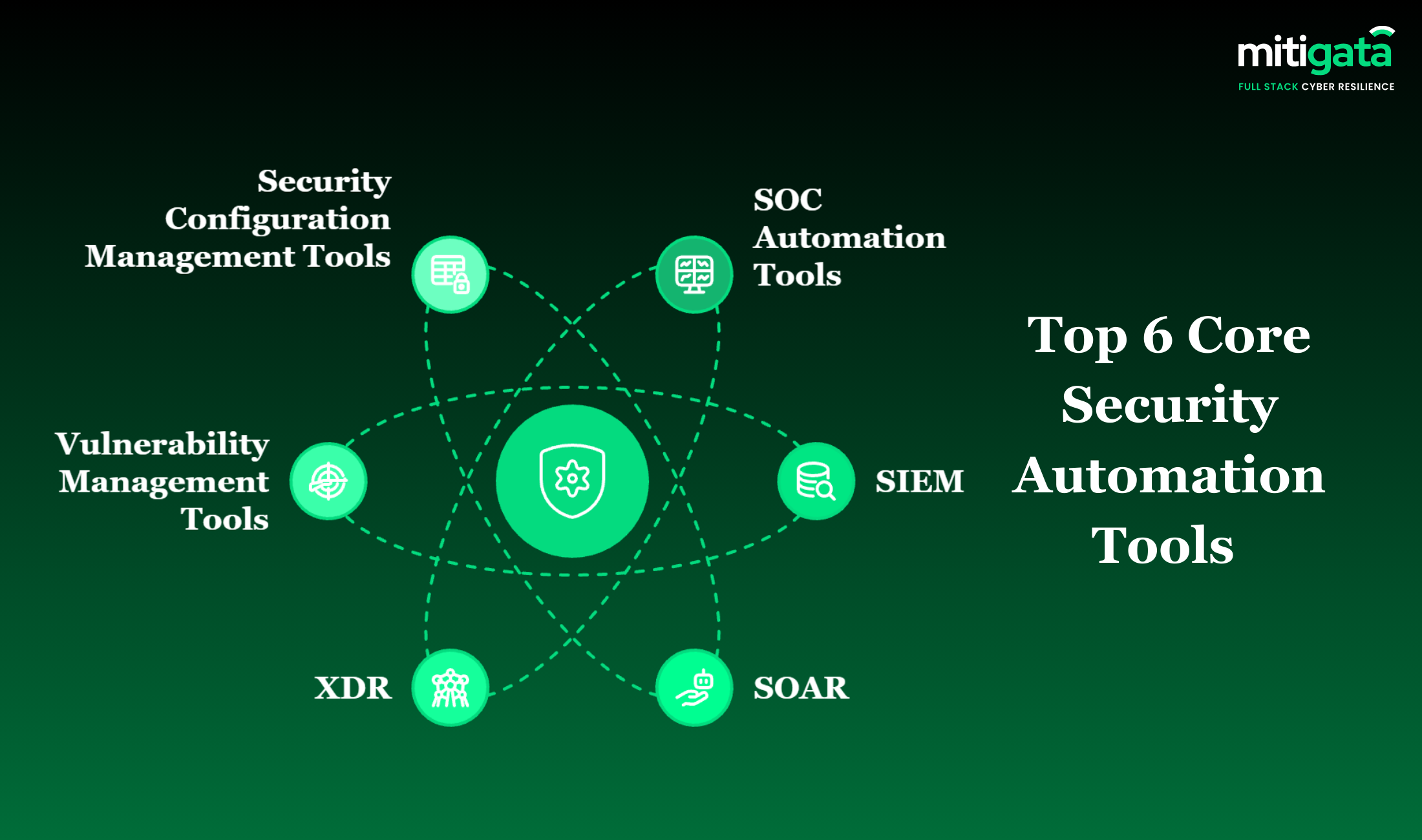
SOC Automation Tools
The evaluation of any threat coming from SIEM, EDR, firewalls, cloud workloads, and identity systems is done through SOC automation tools, which enhance the efficiency of the analysts by using automated workflows.
They get rid of alert enrichment and classification as repetitive steps. They moreover support SOAR automation use cases by clustering alerts, applying logic-based routing, and assigning cases based on severity.
Key capabilities:
- Automated correlation and enrichment
- Priority scoring for high-risk events
- Routing cases to the right team
- Trigger-based workflows for phishing, malware, and access anomalies
- Ticketing and messaging integrations
SIEM (Security Information and Event Management) Systems
SIEM tools are one of the most vital parts of automation in cybersecurity. They gather logs from a variety of sources and use detection rules to highlight suspicious activities. To further mitigate manual work, many SIEMs today come equipped with features like automated log queries, scheduled threat hunts, and integrations with SOAR security tools.
Key capabilities:
- Automated log collection and retention
- Correlation rules for threat pattern recognition
- Automated queries for recurring investigations
- Scheduled compliance reports
- Threat intel integration
Personalised SIEM services starting at just ₹6,00,000/Yearly*
Our solutions adapt to your risks, workflows, and industry needs, giving you smarter coverage without any overpromises.
SOAR (Security Orchestration, Automation, and Response) Platforms
SOAR tools are incident response automation. They help teams standardise investigation steps through their playbooks while reducing the time spent on manual tasks. They seamlessly connect firewalls, EDR, identity systems, cloud platforms, and email security tools.
Key capabilities:
- Automated playbooks for incident response
- Multi-tool orchestration for complete investigations
- Automated evidence gathering and tagging
- Case management from start to finish
- Playbooks aligned to internal security policies
XDR (Extended Detection and Response) Solutions
XDR solutions make it possible to detect threats at several levels: endpoint, network, identity, email, and cloud. The signals that can be treated separately as non-malicious are analysed to be linked, forming a pattern when combined. XDR tools facilitate the automated security evaluation and device isolation for the riskiest cases.
Key capabilities:
- Combined endpoint, network, identity, and cloud telemetry
- Automated response actions, such as user lockout or device isolation
- Behaviour-based detection logic
- Unified investigation timelines
Advanced XDR Solutions at Just ₹1,200/Device
Trusted by 500+ fast-growing businesses and backed by top-tier partners, we give what’s best for you.
Vulnerability Management Tools
These tools automate the discovery of weaknesses for the whole network infrastructure, including systems, applications, cloud workloads, and devices.
Manual vulnerability testing, prioritisation, and patch integration are the main areas where security teams use these tools. A lot of tools now provide exploit-based scoring that ranks the targets based on the likelihood of the attackers hitting them.
Key capabilities:
- Continuous vulnerability scans
- Risk-based scoring models
- Alerts for critical exposures
- Integration with patching systems
- Asset grouping and tracking
Security Configuration Management Tools
Misconfigurations are among the leading causes of data breaches. Security configuration management tools constantly check for unauthorised alterations.
Security teams implement them in the security operation workflow to automatically identify drift across servers, endpoints, cloud resources, and network devices.
Key capabilities:
- Baseline comparison across all assets
- Continuous monitoring for drift
- Alerts for unauthorised configuration changes
- Cloud, server, endpoint, and network coverage
- Reporting for compliance teams
Conclusion
Security automation tools act as a force multiplier for modern security teams. By automating detection, response, scanning, and configuration checks, organisations maintain a stronger and more efficient defence posture.
Automated systems help reduce alert fatigue, strengthen monitoring, and give analysts more time to focus on high-impact threats.
As the threat landscape continues to grow, the use of cybersecurity automation tools will be one of the most practical ways for companies to stay ahead.
Contact Mitigata today for a Free demo and let us streamline your cybersecurity automation!

 akshit k
 areena g