

 deepthi s
Looking back at the cybersecurity events of 2025, one thing is clear: attackers are using methods that do not rely on zero-day exploits.
Ransomware attacks jumped 37% last year, averaging $5.13 million per incident and affecting 78% of organisations.
As cyber incidents escalated across multiple industries, the year offered valuable lessons on where defences failed and how security strategies must evolve.
This blog explores the key cyber events of 2025 and the insights they provide for 2026.
Why Choose Mitigata for Modern Cyber Risk Management
Trusted by 800+ businesses across 25+ industries, we help organisations stay resilient against today’s most common attacks.
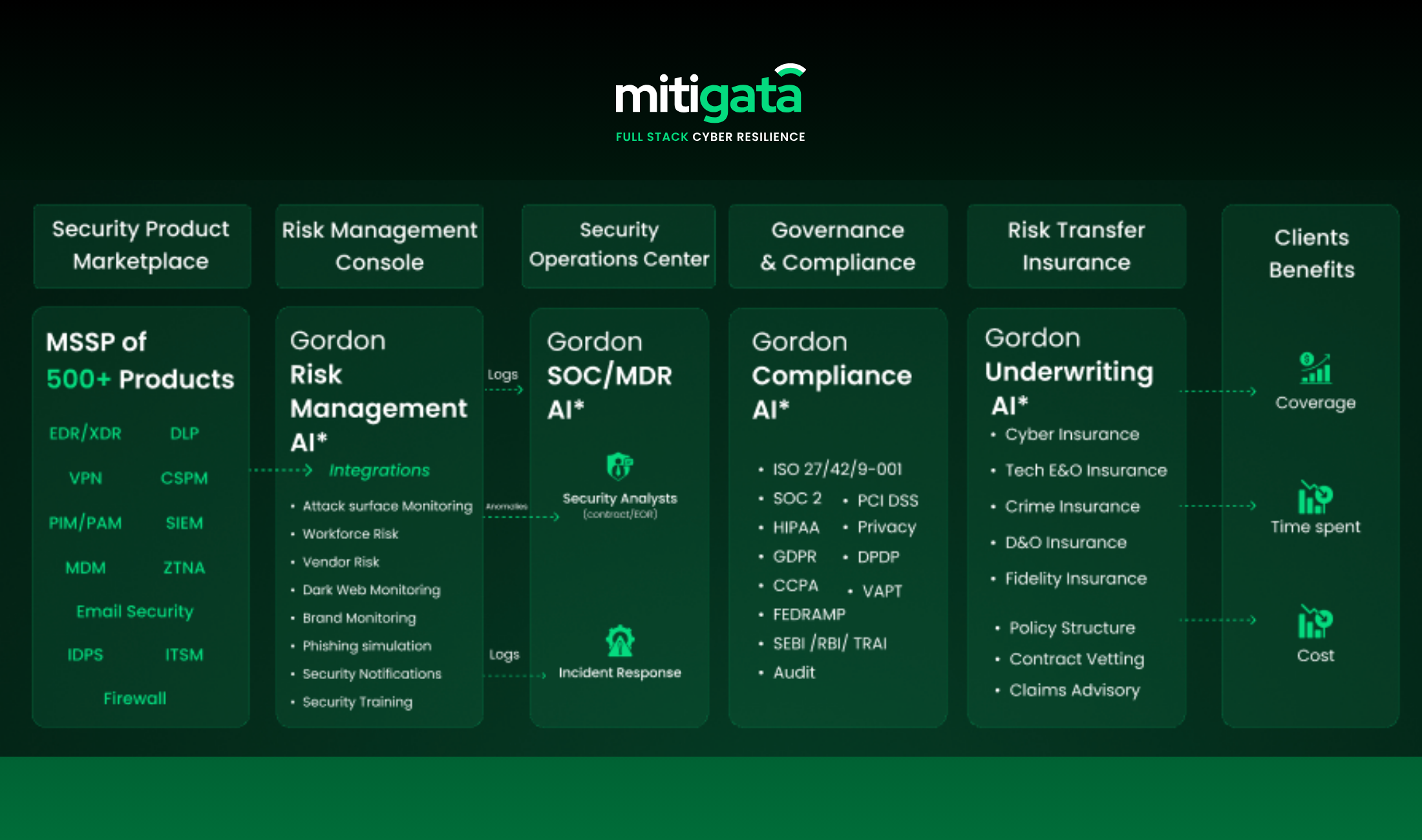
Mitigata enables teams to spot threats early, reduce attack exposure, and stay prepared for an evolving cyber threat landscape.
Key Cybersecurity Trends of 2025: Impact & Lessons
Here’s the list of the most critical cybersecurity incidents of 2025, what caused them, and the key lessons businesses must apply to reduce future risk.
| 2025 Trend | What Happened | Key Lesson |
|---|---|---|
| Aerospace | Collins Aerospace and other factories were locked out of their systems for days, stopping production and shipments. | Attacks now focus on stopping operations. |
| Telecom | Criminals hijacked SIM cards through telecom companies, bypassing security codes sent via text. | SMS-based security is unsafe. |
| Government | St. Paul’s emergency systems were attacked; the National Guard had to help restore them. | Cyber attacks affect public safety. |
| Supply Chain Breaches | Hackers broke into software companies and used their access to attack thousands of customers at once. | Vendor risk must be continuously checked. |
| Aviation | Qantas breach exposed data of ~6 million passengers after attackers tricked a call-centre vendor. | Third-party access is a major risk. |
| FinTech | FinTech made up ~27% of breaches in 2025, with average losses of ~$5.9M per incident. | APIs and vendors need stronger security. |
| HealthTech | Change Healthcare ransomware exposed data of ~190 million patients and disrupted U.S. healthcare services. | Old systems increase breach impact. |
Aerospace Sector:
In 2025, the most critical sectors, including aerospace, manufacturing, logistics, and government services, were among the targets of the attackers.
High-profile incidents affecting organisations such as Collins Aerospace demonstrated how ransomware can disrupt complex production environments and global supply chains.
Understand how spoofing and phishing attacks work and how to stop them early.
The factories were out of operation, governments were taking time to provide services, and recovery was taking weeks rather than days.
Attackers mainly targeted sectors where they could make big profits, not just steal data.
See All Your Risks Clearly on a Single Dashboard
Track open risks, control status, vendor assessments, and audits instantly with Mitigata’s cost-effective and scalable GRC platform.
Telecom Sector:
Hackers found serious loopholes in telecom company networks. They attacked the systems that handle the SIM cards and phone connections, which let them steal identities, spy on people, and break through security checks.
The telecom breaches this year proved that your accounts can be hacked even when you do everything right, because the security depends on phone networks that you don’t control.
Discover essential topics for effective cybersecurity training that empower teams to spot and stop threats
Government Sector:
Cyberattacks targeting municipal systems increased in both frequency and severity.
Among them, the most notable incident is the St. Paul cyberattack, which required the National Guard to restore basic services.
The above incidents clearly showed how cyber risks can impact public safety.
This affected emergency services, utilities, and transportation, causing inconvenience and financial losses, which led to a huge public backlash.
Supply Chain Sector:
Supply chain threats did not occur in a single instance or by mere chance; they were systematically planned across the entire corporation.
The hackers specifically targeted software suppliers, SaaS providers, and service carriers with large customer bases.
The first thing the hackers did was to access the people through whom they later moved undetected.
Such cases were hard to spot because the cyberattack appeared to originate from legitimate, trusted services.
This year, the need for third-party risk management was clear, and it could not rely on annual evaluations, static compliance checklists, or similar practices.
Aviation Sector:
One of the most reported cases was the Qantas breach, where attackers compromised a third-party call-centre platform via vishing, exposing personal data of up to 6 million customers, including names, emails, phone numbers and dates of birth.
Airports in Europe also experienced operational slowdowns after ransomware attacks on aviation technology suppliers.
These incidents happened largely due to over-reliance on third-party vendors, legacy systems, and delayed patching, allowing attackers to move laterally into critical aviation networks.
Fintech Sector :
FinTech breaches inflicted massive financial and data losses, with the sector comprising 27% and average costs hitting $5.9 million per breach.
The root causes were insecure APIs, excessive vendor access, rapid product launches without security hardening, and weak monitoring of cloud environments, making fast-growing FinTech platforms attractive targets.
Health Tech Sector:
HealthTech experienced a major data breach with the Change Healthcare ransomware attack, standing out as the largest U.S. medical data incident on record.
It exposed sensitive patient data for approximately 190 million Americans, including medical records, diagnoses, medications, test results, and insurance details.
Primary Cyber Attack Vectors of 2025
The primary cyber attack vectors of 2025 reveal how quickly attackers adapted to new technologies and security gaps.
AI as an Accelerant for Cyber Attacks:
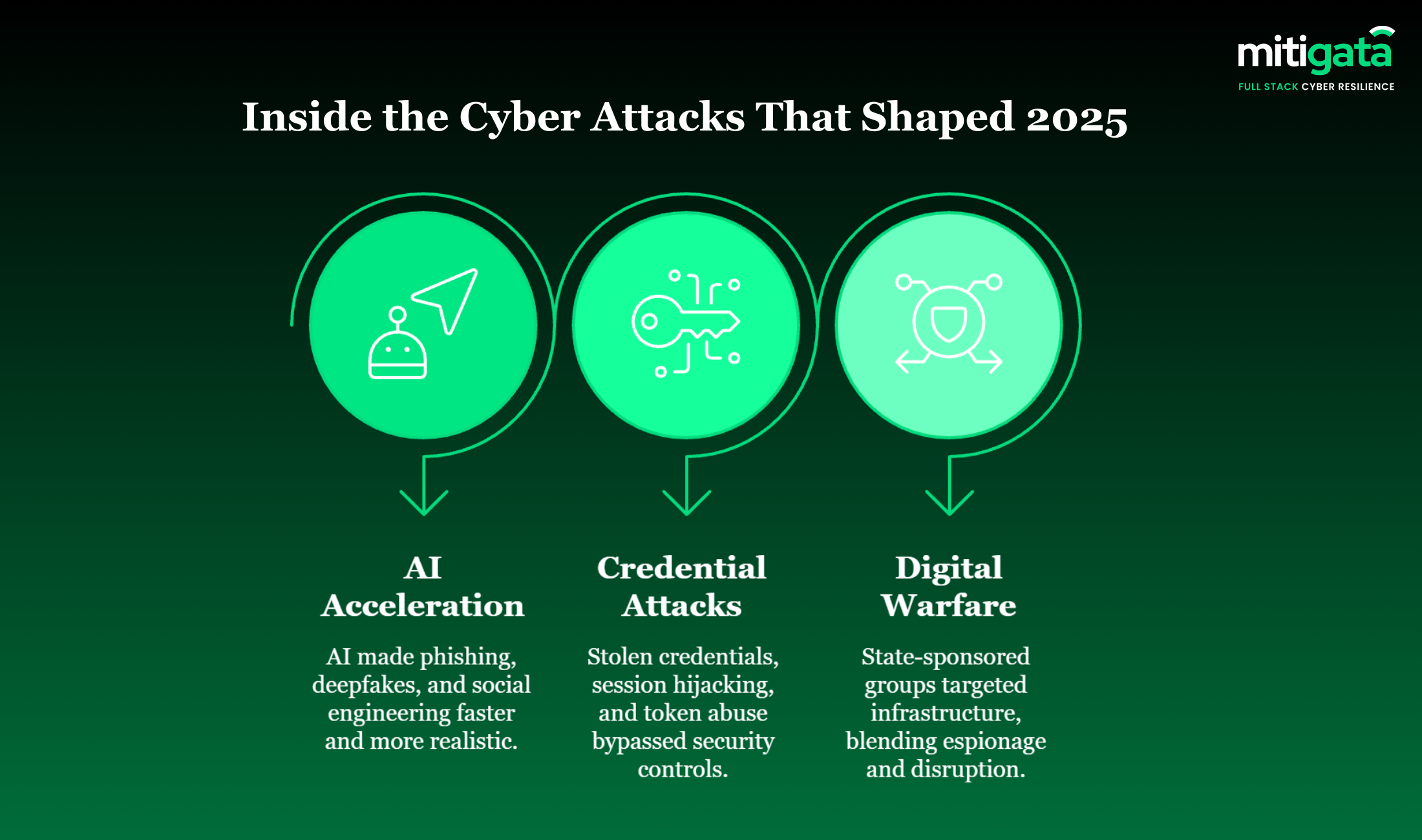
Artificial Intelligence did not introduce new types of attacks in 2025, but it significantly amplified existing ones.
The hackers used AI tools to generate realistic phishing emails, deepfake voice messages, and large-scale impersonation campaigns.
Phishing, Baiting and Whaling have become more difficult to detect, as it has become more individualised and faster to execute.
AI has also made it easier for cybercriminals of all skill levels to put their unethical tactics into practice by equipping them with automated tools.
Train Your Workforce With India’s Leading Phishing Simulation
With 500+ businesses secured, Mitigata’s simulations offer experience-based learning, role-specific campaigns, and regular tests
Credential and Identity Attacks
Identity fraud remained the largest attack sector in the list of cybersecurity incidents in the year 2025.
The methods of credential theft, session hijacking, and token abuse were more common and more successful than the traditional methods based on malware.
Large-scale credential leaks, infostealer malware, and poor password hygiene created a massive pool of reusable access.
Learn how to prevent identity theft and secure your accounts against credential misuse.
Once attackers obtained valid credentials, they could bypass many traditional security controls without triggering alerts.
Identity controls during that period were not up to the mark, as they could neither discover the abuse nor prevent it in real time.
Digital Warfare and Nation-State Activity
By 2025, not only criminals but also state-sponsored groups would be conducting cyberattacks.
These groups combined cyber spying, political influence, and service disruption to create confusion and instability.
The attackers were striking at telecom, government, and vital public service networks, mostly keeping the situation under the radar of open conflict.
This, in turn, made it very difficult to pinpoint the culprits or take proper action.
Consequently, the corporate sector was caught in the cyber wars between nations and exposed to the same risks, even though it was not the primary target.
Take Control of Vendor Risk
With Mitigata
Centralise vendor assessments, due diligence, and monitoring with fast deployment.
Conclusion
The cyber incidents of 2025 showed how quickly trust, identity, and interconnected systems can be exploited.
As we enter 2026, building cyber resilience will be critical.
With the right monitoring, detection, and expert support in place, businesses can stay prepared for what’s next.
As organisations prepare for 2026, Mitigata helps ensure continuous protection against an evolving threat landscape. Get in touch to learn more.

 areena g
 akshit k