

 akshit k
Last updated: January 26, 2026
Cybercriminals are actively exploiting weak network security and outdated firewalls to infiltrate systems in just minutes.
The year 2025 alone saw a rise of more than 160% in credential theft attacks, making such attacks one of the primary reasons for corporate data breaches.
The old-style defences are unable to cope with the present hybrid networks, cloud and encrypted communications.
Choosing the right firewall is where modern protection begins. In this blog, we will discuss the main types of firewalls in network security, how they safeguard your systems, and the business requirements for each option.
Mitigata: India’s Trusted Cyber Security Partner
Mitigata is India’s leading cybersecurity company, supporting 800+ businesses across 25+ sectors. We offer enterprise-grade firewall protection and round-the-clock response at prices up to 30% lower than other vendors.
Reasons why our DLP services are best in the market:
- Enterprise-Grade Security at Better Costs without compromising performance.
- 24/7 Expert Support for rapid assistance
- Seamless Integration with your existing network and tools.
- Comprehensive Training is included at no extra cost.
- Custom Firewall Policies tailored to your environment and risk level.
- Full Lifecycle Management from deployment to continuous monitoring.
- Free Demo to test the product before committing.
Next-Gen Firewalls Starting At Just ₹111,600 for 300 End Points
We handle everything from deployment to monitoring, with real experts guiding you every step of the way.

We handle everything from deployment to monitoring, with real experts guiding you every step of the way.
What Is a Firewall in Network Security?
A firewall is a network security device that monitors and filters data traffic based on existing regulations. It divides the network into trusted internal networks and untrusted external networks, such as the Internet.
The process of firewall operation involves inspecting data packets, checking source and destination addresses, and deciding whether to permit or deny the communication.
Looking to strengthen your network security? Discover the best-rated firewalls trusted by leading businesses.
Main Types of Firewalls in Network Security
The following are the types of firewalls that provide protection to modern networks.
Packet-filtering Firewall
A packet-filtering firewall processes each data packet separately at the network layer. It determines the security levels of incoming and outgoing messages by examining their source and destination IP addresses, protocols, and ports. Then, make a decision on whether to allow or block traffic.
Such firewalls are affordable and easy to install; however, they offer limited protection as they are not able to analyse the data content or the context of the user. They are best suited for small networks or light traffic environments.
Stateful Inspection Firewall
A stateful inspection firewall is a type that monitors existing connections and scrutinises the traffic flow. Packets are filtered one by one, whereas the entire session state is watched in this case, so that every packet is confirmed for being part of a valid and established connection.
The protection offered is stronger, yet at the same time, system resources are more likely to be consumed. This is best suited for mid-sized businesses requiring a thorough inspection of their traffic.
Circuit-Level Gateway Firewall
A circuit-level gateway firewall authorises TCP handshakes between the machines and verifies their legitimacy. It does not scrutinise the contents of the packets but instead certifies the authenticity of the sessions.
The firewalls are placed between the transport and session layers, providing the same level of security without affecting network performance. This is best for networks that require a strict authentication process and, hence, are internal.
Enjoy a FREE demo of NGFW with Mitigata
800+ Businesses Trust Mitigata with NGFW for Complete Protection. From setup to fine-tuning, our experts manage every stage to keep your network secure.
Proxy Firewall (Application-Level Gateway)
A proxy firewall is an intermediary between internet users and the internet. Its functionality occurs at the application layer, where it filters requests and, most importantly, masks internal IPs.
This method not only provides close-up traffic monitoring but also helps ensure data security during transfer by preventing the infiltration of harmful data or its loss. This is best suited for large companies dealing with sensitive applications or user data.
Next-Generation Firewall (NGFW)
A next-generation firewall is a hybrid of a conventional firewall that combines intrusion prevention, deep packet inspection, and application control. To speak a little further about NGFWs, they can also provide excellent threat protection and UTM (Unified Threat Management) integration.
They can tell a virus from a clean file, detect encrypted traffic, and enforce rules based on a user’s identity or device type.
This is best for getting complete visibility and control, which is the requirement of the organisation.
To understand whether your organisation needs an NGFW or a standard firewall, check out our detailed breakdown of the key differences and benefits.
Cloud and Host-Based Firewalls
Cloud firewalls ensure the security of virtual and hybrid environments by controlling the traffic of both cloud workloads and on-premises networks.
On the contrary, host-based firewalls are there to secure the entire device.
Firewall Comparison and Selection Criteria
Each firewall type offers distinct advantages. The table below summarises their differences:
| Firewall Type | Inspection Layer | Best For | Limitation |
|---|---|---|---|
| Packet Filtering | Network | Small networks | Limited filtering capability |
| Stateful Inspection | Transport | Mid-sized networks | High resource usage |
| Circuit-Level Gateway | Session | Internal networks | No packet content inspection |
| Proxy | Application | Enterprise networks | Slower performance |
| Next-Gen Firewall | Multi-layer | Large/Cloud setups | Costlier deployment |
| Cloud/Host Firewall | Cloud/Endpoint | Remote work setups | Policy complexity |
Enjoy a FREE demo of NGFW with Mitigata
800+ Businesses Trust Mitigata with NGFW for Complete Protection. From setup to fine-tuning, our experts manage every stage to keep your network secure.
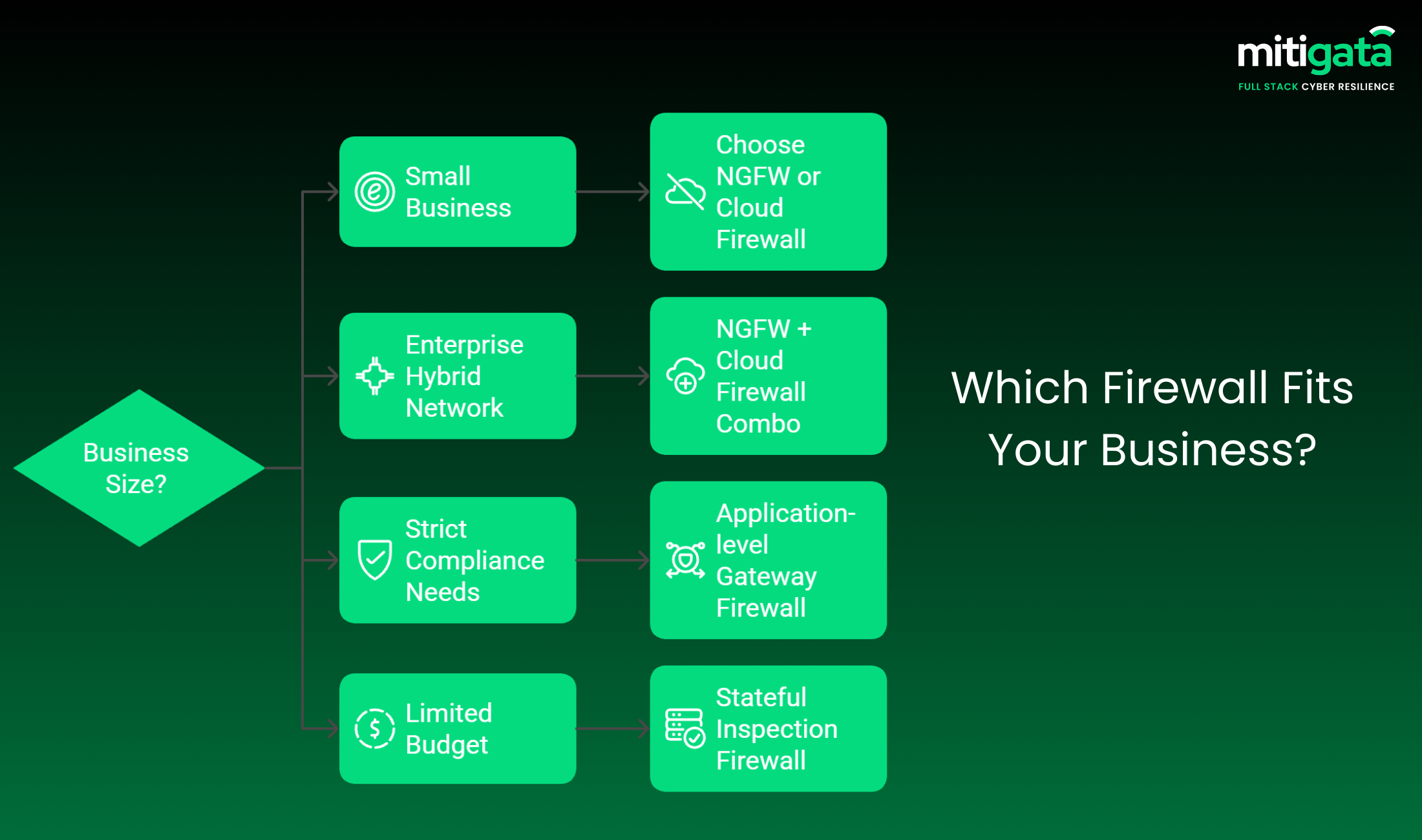
Choosing the Right Firewall for Your Business
For a growing business, relying on a single firewall type can leave visibility gaps. The most effective strategy is layered firewall protection, where packet filtering and next-generation firewalls work together with endpoint protection.
Key firewall selection factors:
- Network size and data sensitivity
- Integration with SIEM or MDR platforms
- Cloud and hybrid compatibility
- Real-time monitoring and automation
Want to learn how to pick the Right Firewall for your Business network? Check out our latest blog
Conclusion
The modern network security system is largely dependent on the most important types of firewalls: packet-filtering, stateful inspection, circuit-level gateway, proxy, next-generation, and cloud firewalls.
Using a mix of firewall types not only creates a layered defence but also maintains visibility throughout hybrid environments.
Get in touch with Mitigata now and get a Free Demo to protect your digital assets with peace of mind.
 areena g