Cyberattacks in 2025 were faster than ever. The average recorded data breach cost was $4.88 million.
Today, security teams need clearer visibility into their networks, faster ways to spot threats, and tighter control over compliance as their IT systems keep expanding.
This is where SIEM comes in. It helps organisations catch risks early and shut them down before they turn into major breaches.
In this blog, we’ll discuss about the top 5 ways companies are using SIEM to strengthen their security and stay one step ahead of attackers.
Mitigata – India’s Best SIEM Service Provider
The majority of organisations evaluate SIEM solutions for six to twelve months, only to encounter deployment issues, receive poor support, or realise they’ve made the wrong decision.
We at Mitigata have resolved this issue with more than 400 businesses.
We simplify SIEM deployment and selection as the leading full-stack cyber resilience firm in India, with over 500+ security solutions and a 100% client retention rate.
Our collaborations with leading companies in the field, including Microsoft Sentinel, IBM QRadar, and Fortinet, give you access to premium solutions without requiring drawn-out processes.
Complete SIEM Coverage at the Best Market Rates
We simplify the tech, secure your stack, and support you 24/7—just ask our 400+ happy clients.
What makes us different:
- End-to-end implementation, from assessment to seamless go-live
- Industry-specific setups aligned to your business needs.
- Smooth Integration without disrupting daily operations.
- Affordable pricing as compared to other vendors.
- Ongoing support even after deployment.
Top SIEM Use Cases
Following are some of the siem use case examples, best for enterprises and growing teams:
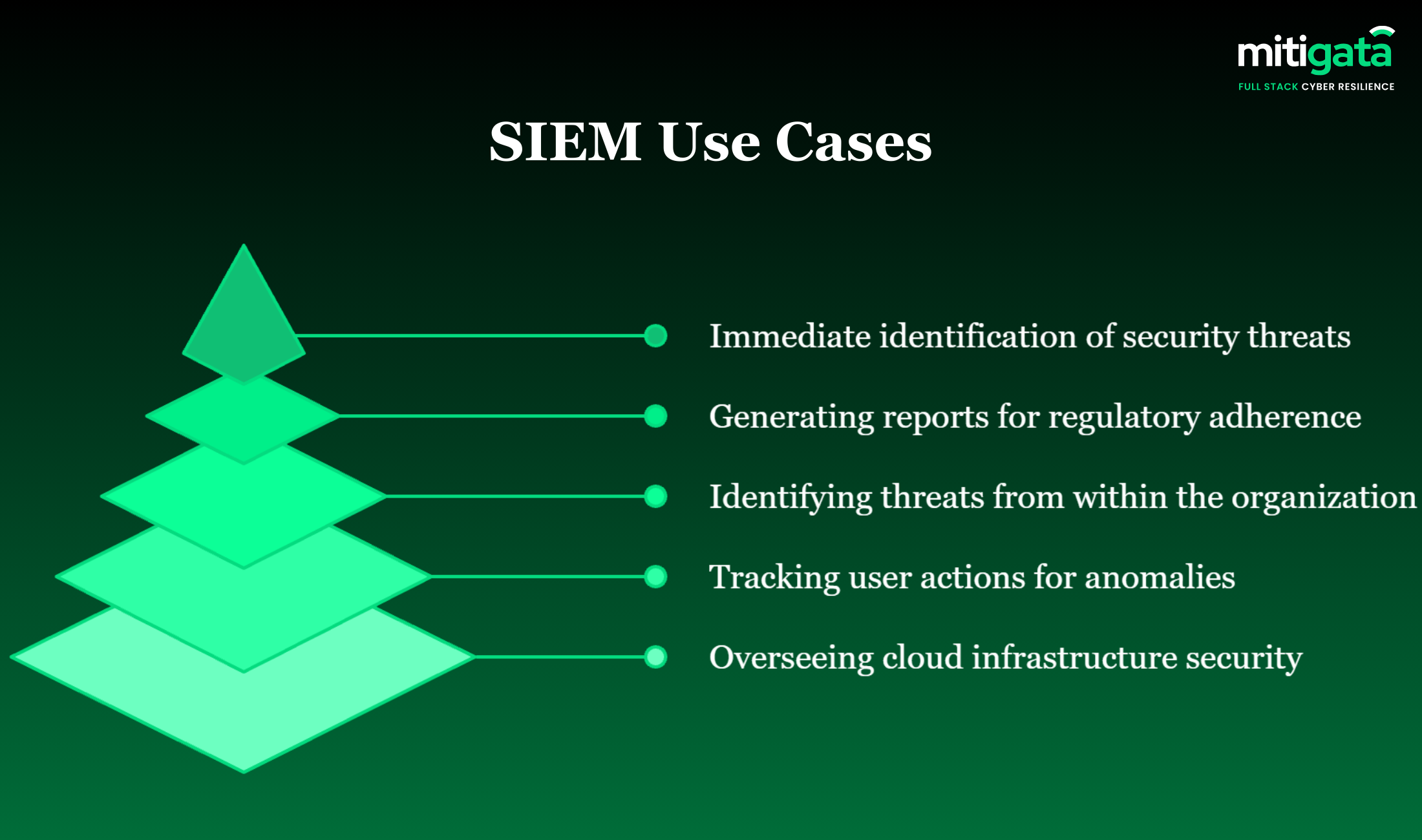
Use Case 1 – Real-Time Threat Detection
SIEM platforms ingest logs from various sources, such as endpoints, firewalls, servers, and applications, and then correlate events to detect unusual behaviour.
An increase in failed logins, suspicious data transfers, or command executions outside business hours can alert SOC teams.
SIEM correlation is critical in this context. A single failed login might seem insignificant.
However, if multiple failed attempts are followed by a successful login from a new location, that is a clear security signal.
Learn how SIEM helps SOC teams detect threats faster and reduce alert overload.
Use Case 2 – Compliance and Audit Reporting
The centralised log management approach is a core part of meeting regulatory requirements.
One of the main functions of security information and event management is to produce compliance reports.
The logs are stored in a tamper-resistant format, and reports for compliance with standards such as ISO 27001, PCI DSS, HIPAA, and GDPR are ready.
SIEM is relied upon for use cases such as automated log retention, user access tracking, and change monitoring during audits to demonstrate compliance.
The issuance of these reports decreases the amount of effort required manually, and at the same time, the gaps during the assessments are limited.
Learn how SIEM simplifies compliance reporting and audit readiness.
Use Case 3 – Insider Threat Monitoring (UEBA)
The insider threat monitoring case explains how UEBA in the SIEM identifies risky behaviour by trusted users.
The threat posed by insiders has been a concern for companies. The Insider Threat Monitoring of SIEM for Active Directory and UEBA can monitor user behaviour over time.
Sudden access to sensitive files, misuse of privileges, and logins at unusual hours are activities that will trigger an alert.
UEBA makes SIEM’s security use cases even more powerful by incorporating behaviour baselines instead of static rules.
If a user is accessing payroll systems for the first time or downloading large data sets without approval, the SOC team will be able to see that.
One Dashboard. Zero Blind Spots
Mitigata’s SIEM services give you complete visibility without complex setup or hidden costs.
Use Case 4 – User Behaviour Monitoring in SIEM
SIEM’s user behaviour monitoring capability is certainly the most important function among its various features.
Nowadays, a lot of cyberattacks are not based on the use of malware; cybercriminals take advantage of stolen or compromised passwords to bypass security unnoticed.
In this situation, SIEM comes up with the solution by determining what normal behaviour looks like for every user: their usual login time, the folders they open, the programs they run, and their rights or restrictions.
In the event of any behavioural deviation, such as logins at odd hours, access to critical systems outside the user’s role, or sudden data downloads, the SIEM will detect and correlate these events.
This will help in detecting insider threats, compromised accounts, and privilege misuse much earlier.
Security teams will also get a clear context around user actions, which will, in turn, quicken the investigation and make the incident response more accurate.
Use Case 5 – Monitoring of Cloud Infrastructure
The cloud use case entails an overview of the cloud utilisation of workloads, users, and APIs.
With increasing cloud adoption, the number of potential cyberattacks also rises.
In fact, the use case in cybersecurity has broadened to include the logs from AWS, Azure, and Google Cloud.
Moreover, minute API calls, risky IAM changes, and exposed storage activity are being vigilantly monitored.
Cloud-oriented use cases in SIEM not only support the effective implementation of the shared responsibility model by identifying misconfigurations and unauthorised access attempts across available environments.
Explore the key advantages of SIEM for stronger security visibility and control.
Conclusion
SIEM transforms cybersecurity with real-time threat detection, compliance reporting, insider monitoring, and cloud oversight, slashing dwell times by 40% and boosting ROI.
Mitigata delivers seamless deployment with free staff training.
Contact Mitigata today for your free SIEM assessment.