
In today’s regulatory world, businesses talk about audits, risks, vendor dependencies, and constant shifts, prompting more frequent checks under laws like India’s DPDP Act 2023, with its strict data rules and hefty fines up to INR 250 crore.
Yet, teams cling to spreadsheets and siloed workflows, leading to missed controls, rushed last-minute audits, and decisions on incomplete data.
A unified GRC platform consolidates risk, compliance, and governance into a single, streamlined system, automating detection and reducing inefficiencies by up to 40%.
This blog dives into GRC’s modern must-have role and includes a step-by-step implementation guide.
Mitigata: India’s Trusted GRC Service Provider
Mitigata is a comprehensive cybersecurity firm that offers an advanced GRC automation platform. This platform provides an up-to-date, consolidated view of your organisation’s risk and compliance status, enabling businesses to monitor and manage risks more efficiently.
What we bring to your table:
Continuous Alignment
The platform keeps your risk and compliance strategies up to date as requirements change, without manual rework.
Cost-Efficient Scaling
Automation replaces repetitive manual work, reducing dependence on external tools and lowering operational effort as you grow.
Instant Gap Alerts
Compliance gaps are flagged in real time, helping teams act early and prevent issues from escalating.
Centralised Oversight
A single dashboard brings risk identification, control management, and compliance reporting together in one place.
Clear Control Tracking
Every task and control is easy to track, whether it is pending, in progress, or completed.
See All Your Risks Clearly on a Single Dashboard
Track open risks, control status, vendor assessments, and audits instantly with Mitigata’s cost-effective and scalable GRC platform.
Why Implementing GRC Matters for Modern Businesses
he majority of organisations today operate with dispersed teams, use cloud software, rely on third-party tools, and comply with various legal requirements.
In the absence of an organised approach to oversee obligations and risks, the teams encounter issues such as working on the same things over and over, differences in reporting, and long audit cycles.
GRC presents a unified way for setting policies, controls, risk management, and audit procedures. It allows the management to understand what is functioning, what requires attention, and where the company is most vulnerable.
The implementation of a formal GRC system also enhances credibility with customers, shareholders, and government authorities, since the data is systematised, authenticated, and accessible for examination at any point in time.
Know more about the best ISO 27001 compliance toolsto streamline security, reduce risk, and stay audit-ready.
The 6-Step GRC Implementation Roadmap
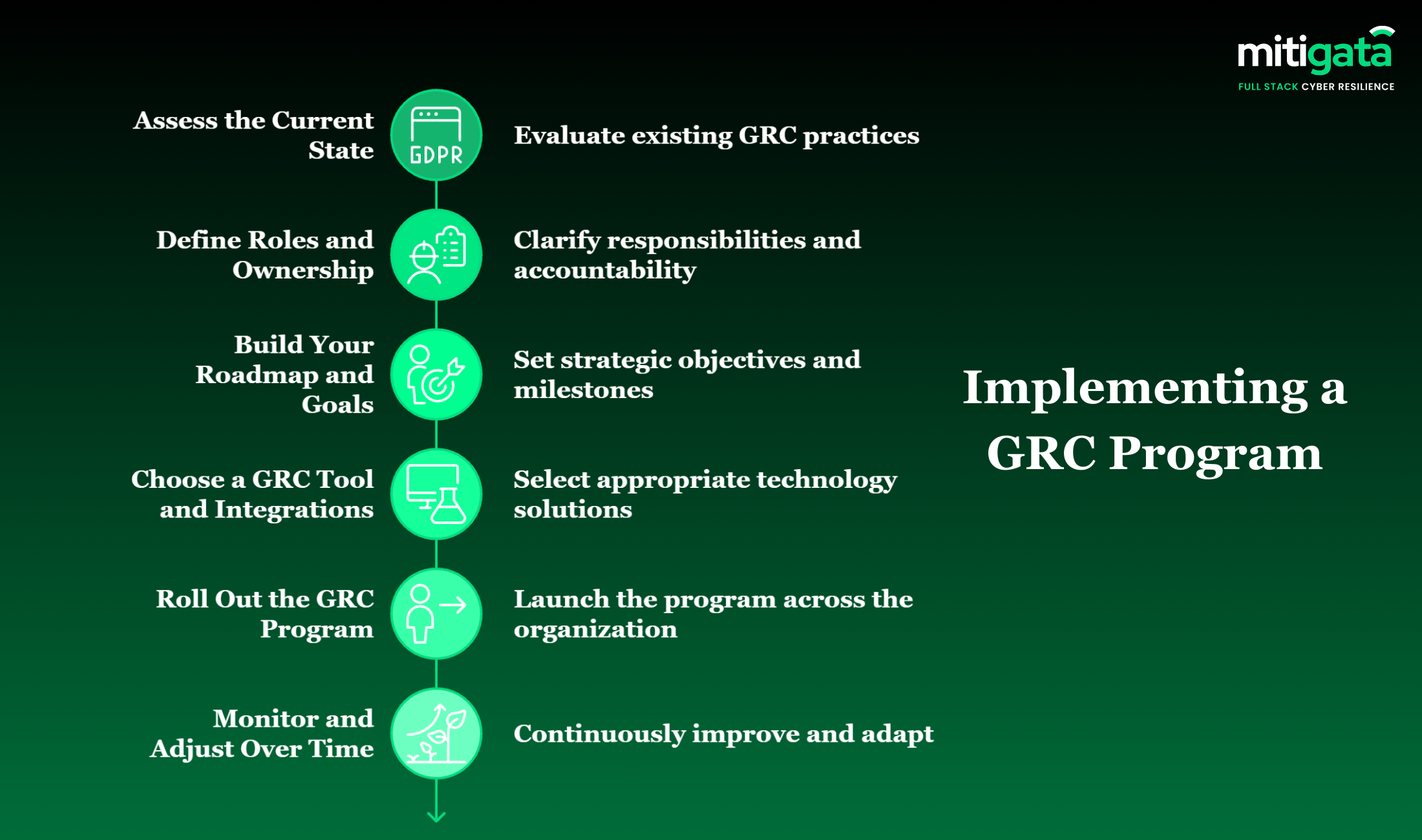
This roadmap breaks GRC implementation into six clear stages, helping teams move from scattered processes to a unified, structured system.
Assess the Current State
To begin, compile an inventory of all existing controls, policies, risks, and requirements for the audit currently underway. Also, it is necessary to visualise the evidence collection process, identify the people responsible for each activity, and identify the areas where gaps exist.
This will provide a very clear view of what requires improvement and the extent to which the team can undertake the change in the first phase.
From Policy to Proof, Manage Everything in One Place
Mitigata GRC streamlines compliance tasks so you save time, reduce errors, and focus on what really matters.
Define Roles and Ownership
Risk, compliance, policy creation, and audit support should each have a designated person responsible. A team comprising various departments will help eliminate the separation between IT, security, HR, and operations.
It should be clearly stated who has the authority to approve policies, who is responsible for monitoring controls, and who evaluates incidents.
Build Your Roadmap and Goals
Make a list of tasks in the order of their priority, such as updating controls, revising policies, reviewing vendors, and conducting audit cycles. Besides, include measurable goals like obtaining evidence more quickly, risk scoring getting better, reducing the time for audit preparation, or uniform policy acceptance.
This will not only help to steer decisions but will also be a guide through the whole process of implementation.
See which SIEM tools lead India’s cybersecurity market with Mitigata’s expert-guide.
Choose a GRC Tool and Integrations
A platform should be selected that allows for evidence automation, policy centralisation, and integration with HR systems, ticketing tools, access management platforms, and security logs.
Consider the availability of features such as workflows, dashboards, version control, and reporting. An effective tool reduces manual work and lets the team focus on improving risk rather than managing it.
Roll Out the GRC Program
Conduct a pilot project at first by picking a small group or a few controls. Users should be taught about workflows, approval routes, evidence uploads, and reporting.
Monitor and Adjust Over Time
The company should conduct regular reviews to monitor the development, fill the gaps, and enhance the control maturity. The performance can be evaluated with the help of KPIs like the duration of the audit cycle, accuracy of the control, readiness of the evidence, and so on.
Reduce your organisational risk through GRC control systems
Try our free demo and discover easy integration, full setup support and unbeatable pricing for long-term security and compliance growth.
Conclusion
Employing a GRC program with a clear structure enables departments to manage compliance-related activities, risk evaluations, and policy changes as well as audits without losing control or being dependent on dispersed documents.
Through evaluating the actual situation, constructing a targeted plan, selecting the suitable software and continuous monitoring, companies can take risks confidently and be prepared for any audit or review.
Ready to simplify risk management? Talk to our experts today and take charge of your organisation’s risk posture with confidence.