

 deepthi s
Last Diwali, a Mumbai retailer lost ₹5 lakhs overnight to insider fraud on POS systems, crippling operations for days.
In 2026, such breaches threaten every store’s survival. The best retail security systems detect threats in real time, prevent losses, and ensure seamless protection.
Choosing the best retail security systems in 2026 will mainly depend on store format, compliance requirements like the DPDP Act, and theft patterns.
This blog will guide you through the best retail security investments to make this year, along with a cost breakdown to help you determine which option is the best fit for your business needs.
Why 400+ Retailers Trust Mitigata for Security
Mitigata is India’s only full-stack cyber resilience company, helping retailers stay secure, compliant, and financially protected. We bring security, insurance, and compliance together under one roof so you don’t have to manage multiple vendors.
What we offer
- Cybersecurity solutions, including SOC, SIEM, IAM, cloud security, and threat detection
- Compliance support for standards retailers must meet
- Cyber insurance coverage that protects against real financial losses after incidents
Why retailers choose Mitigata
- Cost-effective solutions with no hidden training costs
- Easy integration with existing systems and tools
- End-to-end implementation
- 24/7 expert support when it matters most
- Free demo to evaluate before you commit
Top 10 Must-Have Retail Security Systems in 2026
Here are the essential security systems for retailers to invest in 2026:
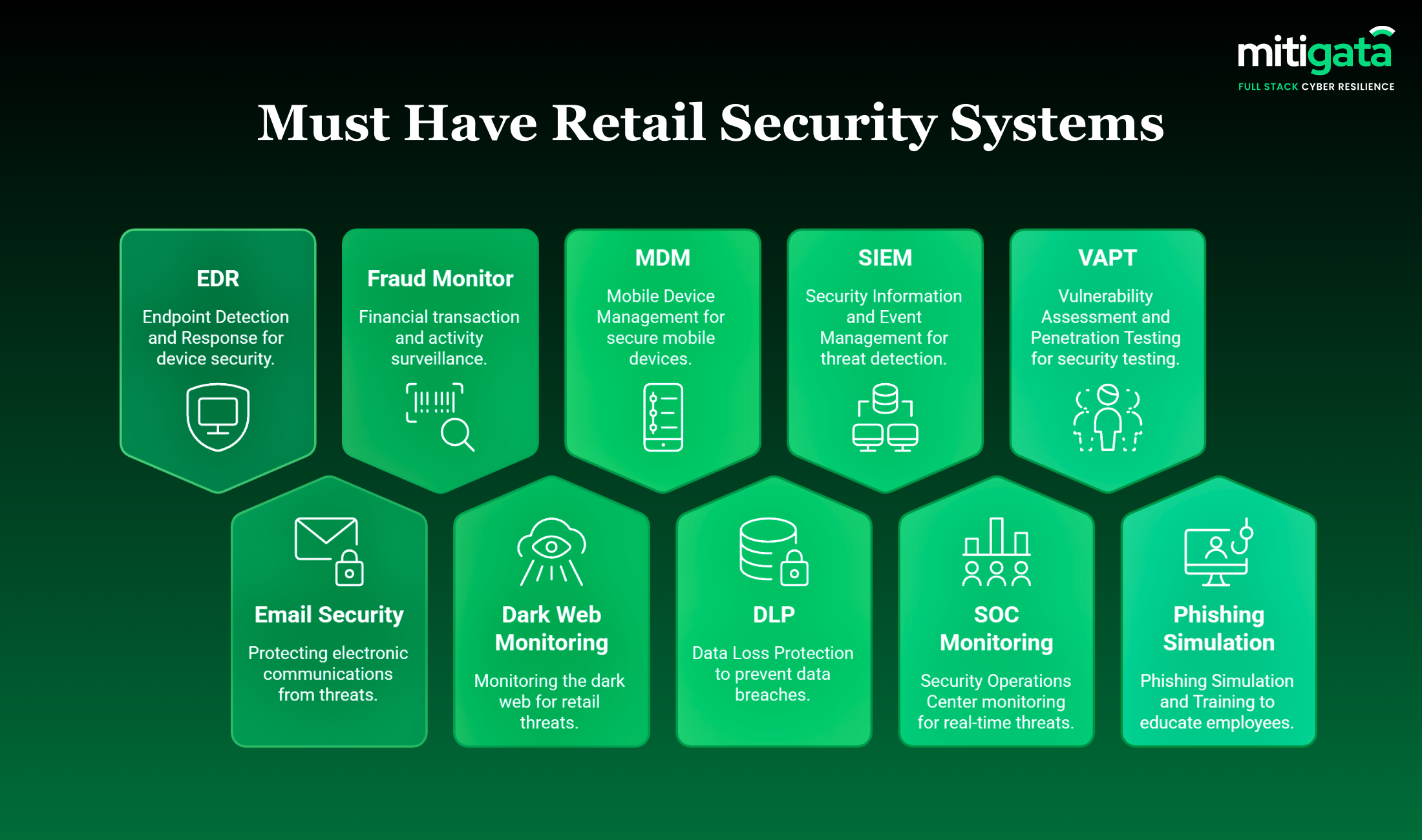
EDR: Endpoint Detection and Response
In a retail setting, there are many endpoints (POS terminals, inventory tablets, back-office PCs). If any of these endpoints are infected with malware, customer payment data may be leaked.
That’s where EDR comes in: it continuously monitors the behaviour of different systems.
With the rise of UPI and digital POS integration, endpoints are the primary entry point for attackers. Traditional antivirus software often misses 60% of modern ransomware attacks.
Example:
A POS terminal starts to act differently, like running an unknown program or transmitting data outside the network, then EDR takes notice and blocks such activity.
This way, retailers can track threats early, before any payment data or store systems are affected.
EDR Without the High Price Tag
At just ₹1,600/endpoint*, get your personalised advanced EDR solution with zero hidden fees.
Email Security: Protecting Electronic Communications
According to recent studies, phishing remains the top attack vector in India, accounting for 18% of all initial breaches. Retail employees receive multiple emails a day from
- Suppliers,
- Logistics partners,
- Banks, and
- Internal departments.
All such emails are filtered by email security measures before reaching inboxes. It verifies links and attachments and checks the sender’s behaviour.
Most cyberattacks start with email. These security services reveal how businesses stop them early.
Fraud Monitor: Financial Transaction and Activity Surveillance
A fraud detection system monitors transactions in real-time. If something suspicious is detected, the system sends an alert to the business immediately.
This gives retailers the opportunity to act quickly and prevent financial losses.
Example: Late at night, a single employee processes several unusually high-value refunds at one location. Manually, this might go unnoticed until the next day, causing losses.
A fraud monitoring system spots these abnormal transactions in real-time and sends an alert, allowing the retailer to pause the refunds and investigate immediately.
Dark Web Monitoring
Once the data is stolen, it often ends up on invisible online marketplaces for sale. Retailers are often unaware of this until the loss is already done.
In fact, the average time to identify and contain a breach in India is approximately 263 days – far too long for a business to remain exposed.
Dark web monitoring is the process of scanning these sites for signs of data leaks related to the company.
Example:
Customer card data from a breach appears on a dark web forum. Dark web monitoring detects it early, so the retailer can reset passwords and warn affected customers before fraud occurs.
Cybercriminals Can’t Hide When Mitigata Monitors Dark Web Threats
Mitigata delivers real-time detection, expert-led response, and market-best pricing for which your budget shouldn’t compromise.
MDM: Mobile Device Management
Retail staff are now using mobile devices more frequently for stock checks, billing, and managing store operations. This “Bring Your Own Device” (BYOD) culture increases risk.
Furthermore, these devices may access store systems from both outside and inside the store.
MDM manages these devices. It divides the professional data from the private usage and establishes access rules.
Example:
If a device is lost or stolen, stored data can be wiped remotely. MDM ensures that even when devices are removed from the store, payment information and internal details remain secure.
Work devices aren’t always secure. These MDM solutions reveal how businesses protect data everywhere.
DLP: Data Loss Protection
Every day, retailers handle highly sensitive information; there are various ways this data could be leaked. DLP monitors the data movement within the organisation.
Example:
If someone attempts to send card information through non-secure channels or upload sensitive files to personal storage, the system will stop such actions.
This also helps retailers maintain PCI-DSS compliance while building and protecting customer trust.
SIEM: Security Information and Event Management
A retailer with several stores will create security alerts across all systems.
SIEM collects all these events into one place. It also relates to similar events throughout the different locations and systems.
Example:
If a threat starts in one store in Delhi and subsequently spreads to a branch in Pune, SIEM helps detect it early on.
This enables faster action as well as more straightforward compliance reporting.
Personalised SIEM services Starting at just ₹6,00,000/Yearly*
Our solutions adapt to your risks, workflows, and industry needs, giving you smarter coverage without any overpromises.
SOC Monitoring
SOC monitoring keeps retail systems under 24/7 surveillance. Analysts monitor alerts, investigate suspicious activity, and respond before damage spreads. This situation is favourable for retailers, as the issues are addressed even when internal teams are offline.
Example:
Malware starts on a POS system at 2 a.m. SOC analysts detect unusual activity immediately and prevent the malware from spreading, keeping stores safe by the time they open.
VAPT: Vulnerability Assessment and Penetration Testing
The retail IT infrastructure consists of websites, mobile applications, POS systems, and payment gateways. And attackers can take advantage of the weakest link.
VAPT tests these systems in advance. Assessments find known gaps, and penetration testing simulates real attacks.
Example:
A security test finds an outdated checkout plugin that could leak card data. Penetration testing simulates an attack, confirms the risk, and the retailer fixes it proactively, reducing the chances of a breach.
Before hiring a VAPT company, understand these critical factors that most businesses overlook.
Phishing Simulation + Training
There is no technology that can absolutely stop every attack. The retail staff, in particular, will always be a target since the attackers rely on human mistakes. Building a “Human Firewall” is your last line of defence.
Hence, invest in cybersecurity training for your employees. To simulate phishing, safe test emails are sent to employees.
The tests will reveal who clicked on the suspicious links and who reported them.
Example:
Employees receive a fake phishing email. Those who click receive targeted training to identify real phishing attempts in the future, reducing the risk of credential or payment data theft.
Conclusion:
Retail security in 2026 goes beyond using a single tool.
With digital payments, online orders and in-store systems, retailers need coordinated protection across all operations.
The right security systems help reduce theft, protect customer data, and keep stores running smoothly.
Contact Mitigata today for expert-led protection, continuous monitoring, and retail-focused security support.

 akshit k
 areena g