


The year 2026 will be a game-changer for India’s retail industry, as the Digital Personal Data Protection (DPDP) Act 2023 becomes standard practice for merchants nationwide.
From kirana stores digitising ledgers to e-commerce brands using AI-driven personalisation.
Everyone is adapting to this data privacy mandate, redefining customer relationships built on loyalty apps and purchase histories.
This blog will guide you through the different roles and requirements, the impact, and the approaches to ensure compliance is a growth driver under the recently enacted Indian data law.
Mitigata – Your DPDP Compliance Partner
Preparing for India’s DPDP Act in retail requires more than policy updates. It requires clear visibility into how customer data is collected at POS counters, in loyalty programs, and on e-commerce platforms.
Mitigata supports retailers at every stage of DPDP readiness with a structured, practical approach.
What we help retailers with:
- DPDP gap assessment to evaluate how your retail systems, policies, and processes align with regulatory requirements
- Retail data mapping to track personal data across stores, websites, apps, POS systems, and third-party vendors
- Consent and notice review to validate consent collected at checkout, sign-ups, promotions, and marketing campaigns
- High-risk processing review covering profiling, automation, sensitive customer data, and cross-border data sharing
- Governance and documentation to define clear roles, responsibilities, and accountability across retail teams
- Security controls that support compliance without disrupting billing, inventory, or customer experience
To support ongoing retail compliance, we developed Dranta, our consent management platform:
- Centralised consent control across all websites
- Customisable consent banners in 22 languages
- Real-time consent logs with audit-ready records
- Actionable, quantified risk reporting for continuous compliance visibility
Buying Cyber Insurance? Start with the Right Partner.
Save more with Mitigata and get exclusive tools to monitor your digital footprint proactively.
Understanding DPDP Act: Retail’s New Rulebook
Understand the following main roles that would help compliance initiatives gain stronger support:
Data Principal
The individual who owns the data you collect, such as telephone numbers or buying habits. They have the right to view, correct, erase, or withdraw consent at any given moment.
Data Fiduciary
The retail entity is responsible for determining the purpose of the data and its processing methods. You are entirely responsible for securing, notifying, and confirming accuracy, and you may face fines of up to ₹250 crore for any errors.
Learn why cyber insurance is essential for e-commerce businesses facing rising threats like payment fraud and data theft.
Data Processor
Third-party vendors, such as payment processors, delivery companies, or customer relationship management (CRM) tools, that get access to your data.
Contracts must present the DPDP through Data Processing Agreements (DPAs), which include audit provisions to confirm it.
The data protection law covers all digital personal data, as well as offline data digitised via POS scans or loyalty cards, thereby affecting physical and digital retail the most.
In 2026, the rules drafts emphasise “notice in simple language” at the time of data collection and limit the purpose to ensure there is no data hoarding.
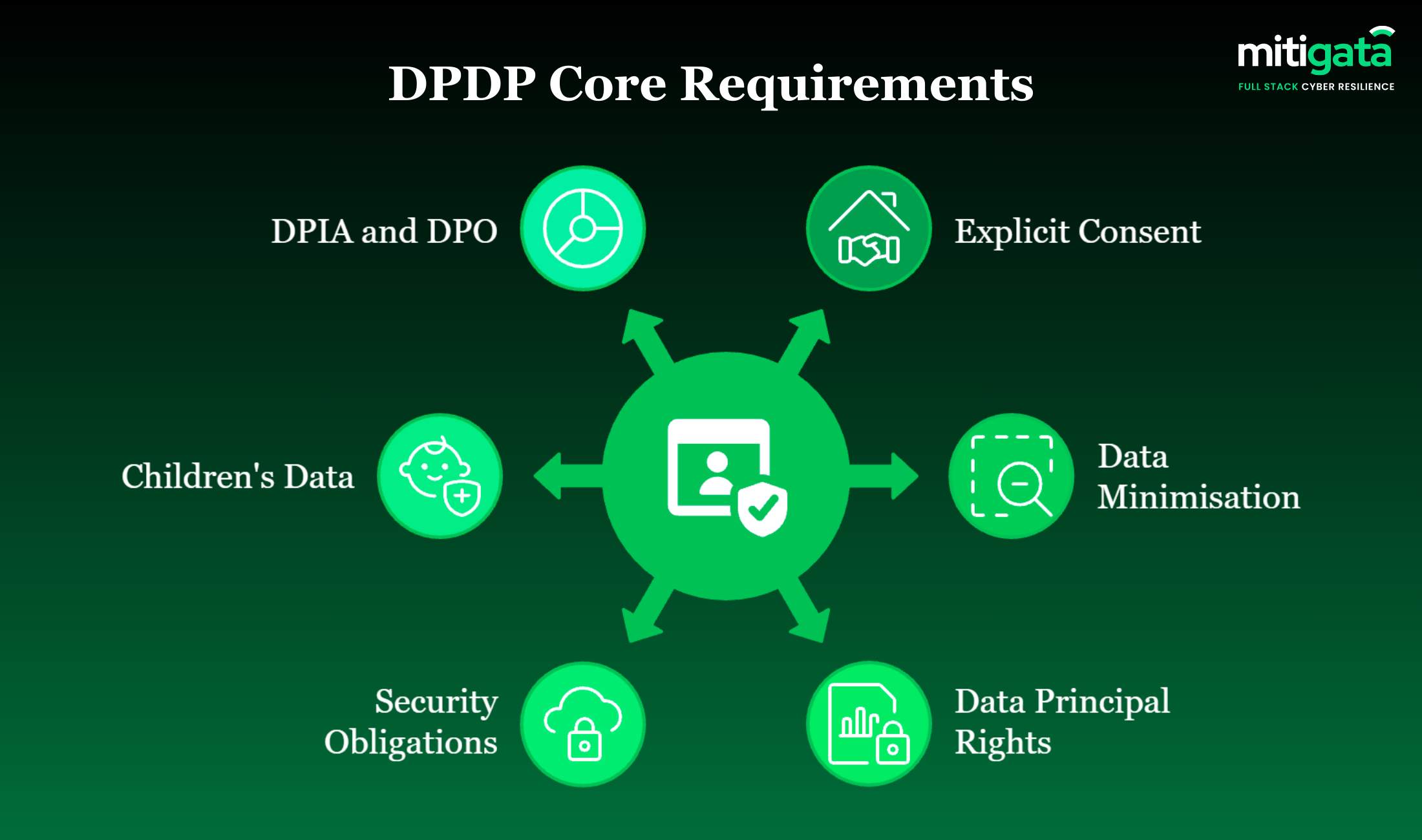
6 Core DPDP Compliance Requirements for Retailers
DPDP compliance for retailers applies across systems, vendors and internal teams. Compliance will be achieved only if policies align with actual retail workflows.
Explicit Consent Management
DPDP consent management in retail requires obtaining explicit consent before collecting or using personal data.
The consent must cover both the data currently stored and previously stored data. Customers should be able to see what they are agreeing to, and the withdrawal process should be seamless.
Once consent is withdrawn, marketing personalisation has to stop immediately. This rule directly affects loyalty offers, SMS campaigns, and app push notifications.
Before choosing an MDM platform, see which solutions in India are actually worth your time and budget.
Data Minimisation and Purpose Limitation
The DPDP Act limits data collection to specified business purposes.
Keeping unnecessary information increases risk without any value. Therefore, less data retention means a smaller scope of audit and a lesser impact of a breach.
Purpose limitation implies that data collected for billing cannot be repurposed for promotions without getting fresh consent. This rule forms better discipline among the teams.
DPDP Phase One Readiness Starts Here
Get a free readiness checklist and CRQ report to understand requirements and prioritise compliance actions today.
Rights of Data Principals
- Customers gain control over their personal data.
- The right of access allows a customer to view the information stored about them.
- The right of correction allows a customer to rectify erroneous records.
- The right of erasure takes effect once consent is revoked or the purpose is fulfilled.
These actions must be supported by retail systems at POS, mobile apps, CRM platforms, and loyalty databases.
Security Obligations and Breach Notification
Personal data protection in Indian retail depends on safeguards that match risk levels.
Retailer security includes encryption, role-based access controls, and monitoring.
The notification timeline begins as soon as a breach is detected. Delays in notifying the authorities increase penalties for non-compliance with the DPDP Act.
What if your security team could respond to threats in seconds, not hours? These cybersecurity automation tools make it possible.
Children’s Data and Cross-Border Transfers
Stricter conditions for obtaining consent apply to retail platforms dealing with children.
Parental consent is a must for data collection and profiling.
Data transfer across borders demands both approval from the jurisdictions and contractual safeguards.
DPIA and DPO Expectations
The processing of high-risk data requires a Data Protection Impact Assessment (DPIA) to be performed.
Retail giants processing sensitive data or data in large volumes need to appoint a Data Protection Officer (DPO).
The DPO will be the one who interlinks the compliance actions, grievance handling, audits, and communication with the regulators.
Challenges and Costs of Non-Compliance
A snapshot of the most common DPDP compliance challenges retailers face and the real business impact behind each gap.
| Challenge | What Goes Wrong | Impact |
|---|---|---|
| Penalties & legal risk | Consent misuse, late breach reporting, and unlawful data use | Fines up to ₹250 crore per violation |
| Brand trust loss | Customers lose confidence after privacy failures | Drop in loyalty, repeat sales, and engagement |
| Legacy systems | POS and CRM lack consent and rights tracking | Slow compliance, higher fix costs |
| Franchise complexity | Unclear responsibility across stores and partners | Audit failures and inconsistent compliance |
| Third-party risk | Vendors mishandle personal data | Retailer still held accountable |
| Internal coordination | Business, IT, and legal teams work in silos | Delays and compliance gaps |
DPDP Phase One Readiness Simplified For Retailers
Use our free DPDP checklist and CRQ report to validate controls and strengthen compliance planning.
Checklist: 10 Must-Do DPDP Steps for Retail Ops
This checklist covers the basic steps retailers need to follow to meet DPDP requirements in day-to-day operations.
- Map customer data flows
- Identify Data Fiduciary and Data Processor roles
- Build DPDP consent architecture
- Review retail loyalty programmes and data policies
- Enable access, correction, and erasure workflows
- Apply data minimisation rules
- Secure third-party contracts
- Appoint a DPO where required
- Conduct DPIA for high-risk processing
- Test breach response readiness
Conclusion
The DPDP Act redefines the entire process of handling personal data in the Indian retail sector across every customer interaction.
As the use of data in retail grows, privacy should be considered an integral part of business operations, not just a legal concern to be addressed later.
Mitigata helps retailers protect customer data and stay aligned with DPDP compliance through expert security and continuous monitoring, so privacy risks stay under control as the business grows.
Talk to us now!